 RACEBOOK 101
 HOW TO BET
 HORSE RACING 101
 TRACK PROFILES
 LIMITS
 FAQ
FAQ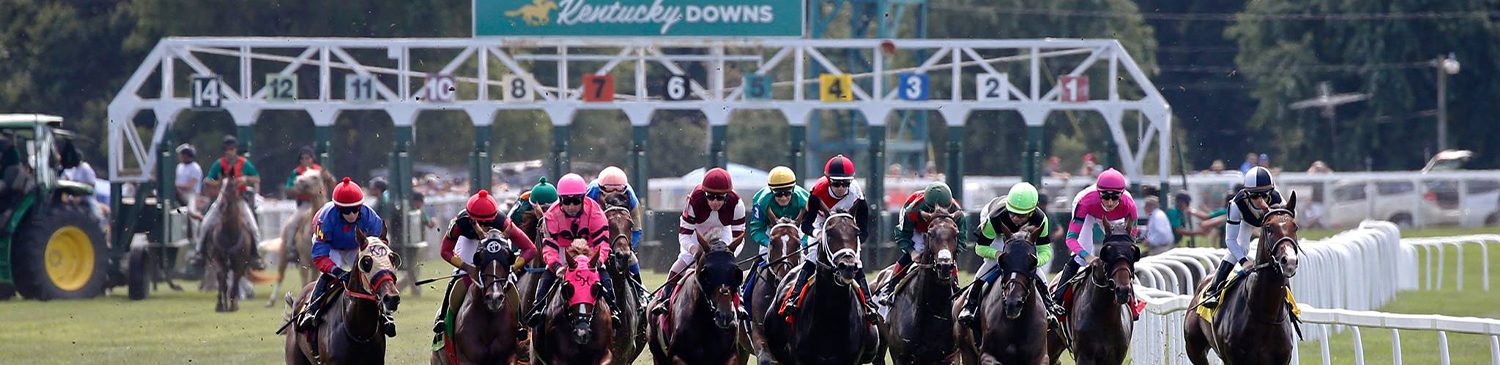
Kentucky Downs
Kentucky Downs is nothing less that Thoroughbred racing’s greatest latter-day achievement, an overnight success story that was 200 years in the making. In a span of two decades its racing was equal in stature to the sport’s most recognizable venues.
The racetrack is situated on a tract of land with its own Historical Marker, #611, indicating the location at which Tennessee gentlemen chose to settle their differences with “honor” in a duel, Kentucky allowed men that “privilege,” Tennessee did not.
The most celebrated duel took place in 1826 between a professional duelist who was the “second” of a postmaster appointed by the opposing party and Sam Houston, the future Governor of the state of Texas, who won the contest over these dueling grounds.
And so when the idea of modern racing in the extreme western part of Kentucky that straddles the Tennessee border was conceived, Lexington horseman Bradley Shannon founded the Simpson County Steeplechase Association and had a racetrack constructed.
Shannon put up a record purse of $750,000 for the International Hurdle, to be contested over a 1-5/16 miles turf course laid out over the gentle rolling farmland, built a clubhouse, and in 1990 named the structure Dueling Grounds, an homage to the land’s history.
After a rocky seven years, Dueling Grounds was shuttered by the Kentucky Racing Commission for failure to distribute purses for the 1996 meeting, the track was rescued out of bankruptcy court in 1997 for $11-million by a fusion of wealthy businessmen, including Churchill Downs and Turfway Park racetracks.
By 2001, the Kentucky Downs Turf Handicap, the current Calumet Farm Kentucky Turf Handicap at 1-1/2 miles, the lynchpin of what is currently a six-day race meet, became the track’s first graded event, rated a Grade 3.
Twenty years later, Kentucky Downs hosts five Grade 3 races in its short session, including the Franklin-Simpson, the county in which the track resides, the Kentucky Downs Turf Sprint and the Kentucky Downs Ladies Turf and Ladies Sprint Stakes. The six-day meet offers nearly $12-million in purses; maidens race for $140,000.
Notably, Kentucky Downs participants have gone on to win major events: Daddys Lil Darling parlayed her Dueling Grounds Oaks victory into a Grade 1 title in Santa Anita’s American Oaks; a Ramsey Farm Stakes winner subsequently won Woodbine’s G1 E. P. Taylor, and Kentucky Cup runnerup Bullards Alley later took the G1 Canadian International.
Of course, they were partnered by present and future Hall of Fame connections: Jose Ortiz, Julien Leparoux, Florent Geroux and Rosie Napravnik have all won multiple riders titles, with Tyler Gaffalione breaking through in 2020.
Among recent multiple meet-winning trainers are horsemen such Ian Wilkes, Wesley Ward, Ken McPeek, and Mike Maker. And it is highly doubtful that any owner can dominate this session the way Ken and Sarah Ramsey have, accounting for nine titles in all.
Kentucky Downs is home to America's only European-style racecourse and at one mile and five sixteenths miles is one of the longest tracks in the country. Unlike typical U.S. racetracks, the course features undulations in a unique layout, one that’s more kidney-shaped than oval.
With subtle elevation changes throughout the course, a sweeping turn into the stretch, and a quarter-mile sprint from the end of the final turn to the finish line, racing at Kentucky Downs is as exciting to view as it is difficult to execute, a serious challenge for both riders and horseplayers.
Races from the chute are considered the most challenging. The initial strides from the gate are straight before a gentle right turn is required, reminiscent of Santa Anita’s Hillside Course, before turning left into a long backstretch followed by a sharper left into the homestretch, one that concludes with an uphill run inside the final furlong.
All this has resulted in enormous percentage increases in purses and wagering that have marked the successful growth of Kentucky Downs, made possible by its nexus with Historical Horse Racing lottery machines, which in 2019 exceeded $1.2-billion in handle.
Over a nine-year period, average purses have gone from $48,000 to $230,000 through 2019, growing field size from 9.57 per race to 11.26, and betting handle on live racing from $12.8 million to $41.2 million, as extraordinary as it is astronomical.
The size of the average daily purse is second in the world only to Japan, and all starters receive an appearance fee for every horse that finishes sixth through 12th of $750.
So, if betting on grass races featuring huge, classy fields, large betting handle, and friendly takeout rates is a challenge you’re willing to accept, the 2021 schedule is set for September 5th-6th, 8th-9th and 11th-12th.