 RACEBOOK 101
 HOW TO BET
 HORSE RACING 101
 TRACK PROFILES
 LIMITS
 FAQ
FAQ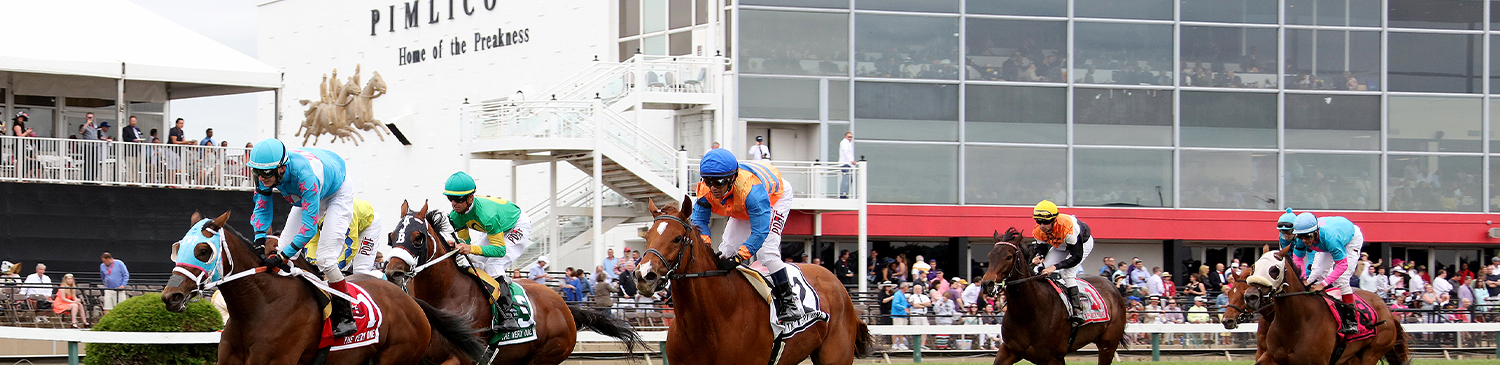
Pimlico
The first thing one notices about Pimlico Race Course in Baltimore, Maryland is that the venue was named for the ground upon which it stands more than a century before the track came into existence.
Back in the 1660s, British settlers named the tract of land in honor of a most watering hole in London, “Olde Ben Pimlico’s Tavern.” And the partying; win, lose or dead-heat, has not stopped since.
The first feature race run on opening day in the fall of 1970 was the Dinner Party Stakes, won by a horse named Preakness. So beloved was Preakness that three years later the Dinner Party was renamed the Preakness Stakes which became the Triple Crown’s middle jewel, of course.
As history has taught us, many of America’s most notable racetracks are steeped in tradition and Pimlico is no exception, providing rich color to racing’s tapestry. Said racing scion Alfred Gwynne Vanderbilt of the place:
"Pimlico is more than a dirt track bounded by four streets. It is an accepted American institution, devoted to the best interests of a great sport, graced by time, respected for its honorable past."
In addition to Preakness, Pimlico is best known for “The Match,” 1937 Triple Crown champion War Admiral against the redoubtable West Coast legend, Seabiscuit. On November 1, 1938, Seabiscuit proved best on the day.
Over 43,000 witnessed “the race stopped a nation” as countless others listened to the first horse racing race broadcast nationally on radio, giving momentary respite to a country suffering through the Great Depression.
There was another less celebrated match race, among three horses, a race that stopped a government--the United States Congress shut down for the day so that its members could attend Pimlico on October 24, 1870.
This match pitted a trio of champions at 2-1/2 miles: Kentucky champion Ten Broeck, vs. Eastern champion Tom Ochiltree, vs. the prodigious gelding, Parole.
Parole won the match beneath jockey William Barrett by three lengths over Ten Broeck, who finished six lengths ahead of pacesetting Tom Ochiltree. Over 20,000 fans were at “Old Hilltop” to witness the first “Great Match.”
Throughout time, Pimlico was forced to weather many storms not of its own making, such as the Great Fire of 1904, the aforementioned Depression, two World Wars, Prohibition, an anti-gambling movement in 1910 and even some notable riots. It has survived, obviously, but much has changed.
In 2010, two Maryland Jockey Club [MJC] tracks, the other being Laurel Park, was sold by Magna Entertainment to parent MI Development in a partnership with co-owner/operator, Penn National. In 2011, current owner The Stronach Group took over, buying Penn National’s minority share of the MJC.
In 2017, the Maryland Stadium Authority issued a study stating that Pimlico would require $250 million in renovations. After negotiations lasting 2-1/2 years, The Stronach Group (TSG), reached an agreement with the city and horsemen:
The Preakness would remain in Baltimore, TSG would donate both tracks to state government agencies who would oversee the properties, in exchange for a license permitting TSG to conduct racing at Pimlico and Laurel Park.
According to the terms, the Pimlico grandstand would be demolished and replaced by a smaller structure but with temporary seating to handle Preakness week attendance.
The new venue would be rotated 30 degrees to facilitate nine parcels of land to be sold for future development. In 2020, the Maryland Stadium Authority was granted power by the Maryland state legislature to issue $375 million in bonds to renovate both tracks. And so Maryland’s racing tradition continues.
Pimlico is a one-mile dirt oval surrounding a 7-furlong turf course and can house 1,000 horses. It’s current capacity is over 120,000, the record set on Preakness Day, 2007, with 121,263 fans in attendance.
In addition to Preakness, Pimlico also features the Pimlico Special for the handicap division at the same 1-3/16 miles distance.
As the Kentucky Derby has the Kentucky Oaks for fillies, Pimlico hosts the Black-Eyed Susan Stakes on Preakness eve. In addition, Pimlico’s stakes schedule offers seven more graded events and 12 listed stakes.
Pimlico is enriched by Preakness history. The race actually pre-dates the Kentucky Derby by two years. Its 1873 inaugural carried a purse of $1,000. In 1946, the Preakness became a “hundred grander.” In 2014, the “Run for the Black-Eyed Susans” carried a purse of $1.5 million.
When the winner returns to be draped in a blanket of the Maryland state flower, the owners receive a replica of the Woodlawn Vase, the permanent trophy the most expensive in all of sports.
Survivor won the inaugural running of the Preakness by 10 lengths, a record that stood until Smarty Jones’ 11-1/2 length margin eclipsed it in 2004. The race is scheduled to be renewed for the 146th time on May 15th, 2021.
While its distance is currently 1-3/16 miles, it had been run at six other trips, from a mile to a mile and-a-half. It was run as a handicap several times, races that included older horses. Eighteen renewals were held in New York at the turn of the 20th Century, at Morris Park in the Bronx and Gravesend Racetrack in Coney Island.
Jockey Eddie Arcaro rode the most winners, six, coinciding with seven victories by leading owner and breeder, Calumet Farm. R Wyndham Walden trained seven Preakness champions in the 1800s. Bob Baffert in the latter-day leader, also with seven.
Six fillies have won the Preakness, most notably Hall of Famer Rachel Alexandra and last year’s filly champion, Swiss Skyrider. In addition to all the Triple Crown champions, winners of the Preakness are members of equine royalty. To wit:
Vanderbilt great Native Dancer in 1953, prodigious progenitors Bold Ruler and Northern Dancer, and a host of other greats including Damascus, Alysheba, Risen Star, Sunday Silence, Point Given, Curlin and a handsome chestnut who amassed the most equine groupies ever, California Chrome.