 RACEBOOK 101
 HOW TO BET
 HORSE RACING 101
 TRACK PROFILES
 LIMITS
 FAQ
FAQ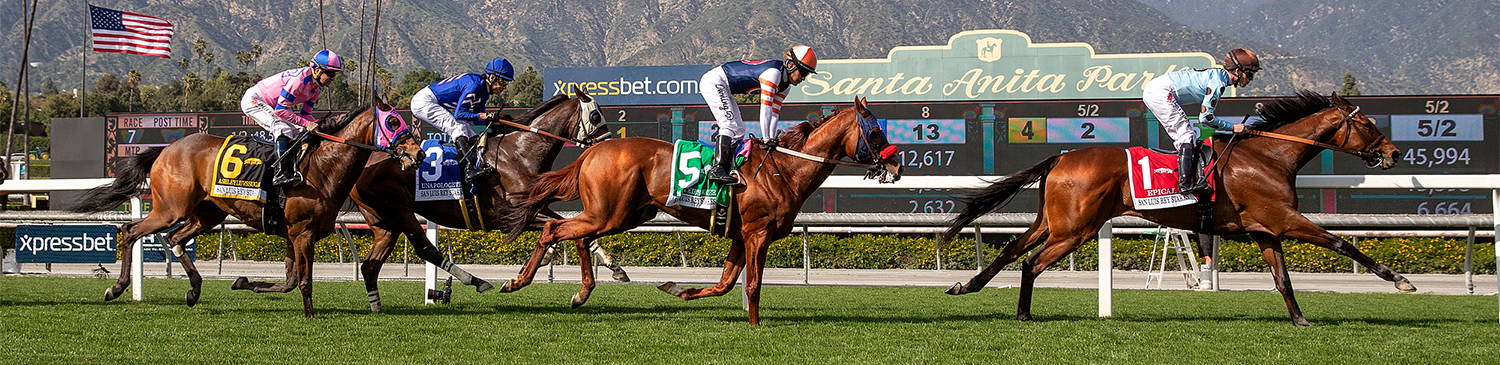
Santa Anita
In 1904, Lucky Baldwin had an idea to reconstruct the Rancho Santa Anita Mission in the shadow of the San Gabriel Mountains. Thirty years later the present Santa Anita Park opened on Christmas Day 1934, standing adjacent to the Baldwin original, and is widely regarded as Thoroughbred racing’s most beautiful venue.
Despite its relative youth, Santa Anita has enjoyed a history as varied and colorful as it is rich. It was opened and closed several times by decree. It was shuttered during World War II. It even burned to the ground once, yet it managed to survive, and then some.
The turning point came in 1933 when the state of California legalized horse race wagering. A San Francisco investment group headed by Charles Strub, and investors from Los Angeles led by movie producer Hal Roach, needed seed money to build a racetrack. Eventually the groups merged and formed the Los Angeles Turf Club. The result was the present Santa Anita Park.
Given the sport’s glitz and glamour and its proximity to Hollywood, the track attracted legendary movie stars. In its early years, luminaries Betty Grable, Lana Turner, Edgar Bergen, Jane Russell, Cary Grant, Esther Williams, Bing Crosby, and Al Jolson found their way to Arcadia, many becoming stockholders. It was the place to see and be seen.
The track inhabits 320 acres, has a 1,100-foot long grandstand, large enough to seat 26,000 fans. Its 61 barns houses 2,000 horses. Its infield can accommodate 50,000 more racegoers. And in 2006, Santa Anita was recognized in the National Register of Historic places.
While its racing history gave the sport many of its most memorable moments--Seabiscuit’s victorious career finale in the 1940 Santa Anita Handicap leaps to mind--some of its non-racing history is ignominious.
In 1942, racing at was suspended due to the Second World War. President Franklin D Roosevelt issued an executive order at the time that authorized the military was to exclude “any and all persons from certain areas” in the name of national security. And so Santa Anita became an "assembly center" for Japanese Americans.
For seven months, more than 18,000 people were interred in horse stables and military-style barracks constructed on the grounds, including a young George Takei, an activist who earlier became famous as helmsman Hikaru Sulu of the Starship Enterprise in the hit television series Star Trek.
After the war ended, Santa Anita reopened in 1945 and enjoyed America’s new prosperity. The track decided to add a little European ambience and constructed a downhill turf course. Prior to the birth of Kentucky Downs, Santa Anita was the only track in America to feature a right-handed bend. That wasn’t Santa Anita’s only nod to European racing tradition.
The track also features a European-style paddock in which statues representing the greats that made Santa Anita the “Great Race Place” it is. There’s one of legendary jockey George Wolfe who filled in so ably for the injured Red Pollard on Seabiscuit for his vengeful and memorable Santa Anita Handicap swansong.
Hall of Famers Johnny Longden, Bill Shoemaker and Laffit Pincay, Jr. who all dominated Santa Anita in their day are there with Wolfe. There’s also a bust of legendary track announcer Joe Hernandez who called the action. And Hall of Fame trainer Charlie Whittingham is so revered at Santa Anita that he is memorialized in that same ring with his trusty dog Toby by his side.
The life-size bronze of Seabiscuit is not the only equine to grace the paddock. The great John Henry was remembered in bronze at the opening of the 2009 racing season. Three years later, before the running of a race named in her honor, a bronze of the mighty Zenyatta, who beat males in the indelible Breeders’ Cup Classic of 2009, was unveiled.
While the Santa Anita Handicap, dubbed the ‘Big ‘Cap’ in honor of the first American racetrack to offer a $100,000 purse, is a seminal event, the Santa Anita Derby etched its place in racing lore long before Bob Baffert trained quarter-horses.
The Santa Anita Derby made headlines throughout the country in 1958 when legendary Silky Sullivan came from 28 lengths behind to win the mile and-an-eighth going away in front of 61,123 fans and a nationally televised audience.
Santa Anita’s modern epoch has not been without its challenges, however. In early March of 2019, all races were cancelled following the 21st fatality of its prime winter racing season following an unusually wet rainy season. Racing resumed later that month, only to be suspended again.
In all, 37 horses died at the facility that season resulting in changes made by the California Racing Commission. The Stronach Group issued a lifetime ban to a Hall of Fame trainer after four horses under his care died within a fortnight, not only at Santa Anita but all of its Thoroughbred tracks. Presently, California has the most stringent safety rules in the country.
Santa Anita is a one-mile dirt oval surrounding a turf course that measures 0.9 miles. The unique hillside turf course crosses the dirt and had been used mainly to run turf races of "about" 6½ furlongs and marathon distances of 1¼ miles, 1½ miles and about 1¾ miles.
Downhill sprints are no longer featured on the Hillside course. In the summer of 2020, Santa Anita broke ground on a new backstretch turf chute. The new chute is used primarily for turf sprints at distances up to 6½ furlongs. The hillside turf course is currently used exclusively for distance racing.
The Cushion Track era at Santa Anita began in the fall of 2007 but after the track lost 11 racing days in 2008 due to a drainage problem with the new material that required intensive maintenance. A newer synthetic surface was installed but also encountered issues. Santa Anita replaced its’ synthetic track with a new all-natural dirt surface by opening day of 2010.
The combination of seasonal fall weather, beautiful aesthetics, and a time zone that allows the Classic to be televised in prime time, Santa Anita has hosted the Breeders’ Cup World Championships a record 10 times, producing ,more than its share of memorable moments:
In 1993, Arcangues won the Classic which remains in the biggest upset in the race's history at 133-1. In 2003, trainer Richard Mandella wins a record four races on a single-day program, including the Classic. In 2009, Zenyatta became the first [and to date only] mare to win the Classic and in 2016, Arrogate won the Classic in a thriller over the popular heavy favorite, California Chrome.
Of course Santa Anita does not live on Breeders’ Cup alone. At present, the track presents 80 graded stakes, including 33 Grade 3s, 32 Grade 2s and 15 Grade 1 titles. Santa Anita remains one of the sport’s great treasures.