 RACEBOOK 101
 HOW TO BET
 HORSE RACING 101
 TRACK PROFILES
 LIMITS
 FAQ
FAQ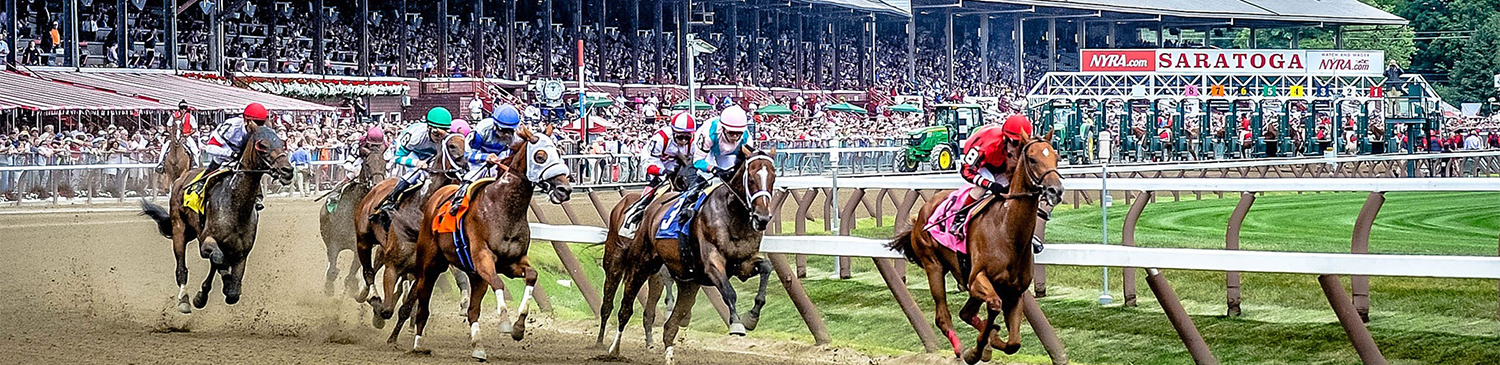
Saratoga
Racing fans and horsemen often can disagree but there would be not much disharmony among either group who think that winning a race or cashing a bet is sweeter at the Race Course on Union Avenue than it is anywhere else, such is the allure of Saratoga.
It’s widely held belief that Saratoga Race Course is America’s oldest is not supported by facts. Indeed, Saratoga is America’s fourth oldest track, ranking behind Empire Race Course, founded about 30 miles south of here, followed by New Jersey’s Freehold Raceway and Louisiana’s Fairgrounds racetrack.
Still, the fabled words of New York Times sportswriter Red Smith applies, even in an era of fake news: “Take Route 87 north, make a right at Exit 14 and go back a hundred years.” Saratogians define the local culture in three words, visible on signposts as you enter town.
Saratoga: “History, Health and Horses.”
The racetrack was founded as a site for standardbred racing in 1847. Known as Horse Haven, it was located across the street from the present location, close to the area now known as the Oklahoma Training Track, which is used for stabling and training.
Nineteen years later, John Morrissey, a professional prize fighter turned casino operator turned Congressman, organized the first Thoroughbred race meet and the following year opened Saratoga Race Course with John Hunter, the Jockey Club’s first chairman, William R. Travers, and William Jerome, who later built Jerome Park in the Bronx.
For all its iconic races--the Travers Stakes, the oldest major race run in the United States—first run in 1864; the Alabama Stakes, inaugurated eight years later; the Hopeful Stakes, established in 1903, and the Whitney Stakes, formerly a handicap, is the relative newcomer, first run in 1928.
For all the great races and great horses that have won here—five-time Horse of the Year Kelso won three Whitney Handicaps, his last as an eight year old—Saratoga is more celebrated for shocking defeats than it is for victories by prodigious champions, hence the nickname “Graveyard of Champions”:
Man o’ War suffered his only lifetime loss when beaten by Upset in the 1919 Sanford Stakes; Jim Dandy defeated 1930 Triple Crown champion Gallant Fox in the Travers at odds of 100-1, and the mighty Secretariat lost to Onion in the 1973 Whitney.
And the list doesn’t end there: Reigning Horse of the Year Rachel Alexandra lost the Personal Ensign to the relatively unknown Persistently, and Keen Ice handed Triple Crown champion American Pharoah his second lifetime defeat in the 2015 Travers.
The nuts and bolts of the course are these: Saratoga is a nine furlong dirt oval surrounding two turf courses, the main Mellon Course at one mile, and the 7-furlong Inner Turf, over which two graded stakes races including the Grade 1 New York Turf Writers Cup Handicap is run for the steeplechase set.
Behind the main track, in the barn area, is Clare Court, a mini-oval used for jogging, inside of which is buried four celebrated Saratoga runners; Irish-bred Mourjane, and notable winners Fourstardave, Quick Call and A Phenomenon. Ill-fated champion Go for Wand is buried near the finish line in the Saratoga infield.
The list of champions that have run and won here are incalculable, as are many legendary horsemen who have saddled champions. Of particular note are Allen Jerkens, Bill Mott, Shug McGaughey, Todd Pletcher, D Wayne Lukas, MacKenzie Miller, Elliot Burch and John M Gaver Sr.
Among jockeys, all the Hall of Famers have passed through these gates, starting with Angel Cordero Jr., “the King of Saratoga,” as well as Johnny Velazquez, Jerry Bailey, Pat Day, Braulio Baeza, Eddie Arcaro, and a host of others.
Designated by Sports Illustrated at #10 in the Top 20 Sports Venues of America, Saratoga’s landmarks and tradition have become part of its legendary tapestry.
Saratoga is known for its healing waters of the Big Red Spring, its trademarked infield gazebo, the tall wooden stand where shoe changes were noted, a hand-rung bell that still exists, its high-pitched gong calling jockeys to the paddock at 17 minutes to post time, and where once one-mile races began from the Wilson Mile Chute.
The chute necessitated a straight run from the clubhouse area before making a hard left turn into the backstretch. It was eliminated in the 1990s. The only chute like it now is at Ellis Park in western Kentucky. Mile races are no longer run at “The Spa.”
Saratoga is part of American culture, celebrated in cinema, Diamonds Are Forever; in song, You’re So Vain and Adelaide’s Lament from 1950s theater production of Guys and Dolls, fitting for a race course that has run every year but five since its inception in 1864. Simply stated, Saratoga is singular among American racetracks.