 RACEBOOK 101
 HOW TO BET
 HORSE RACING 101
 TRACK PROFILES
 LIMITS
 FAQ
FAQ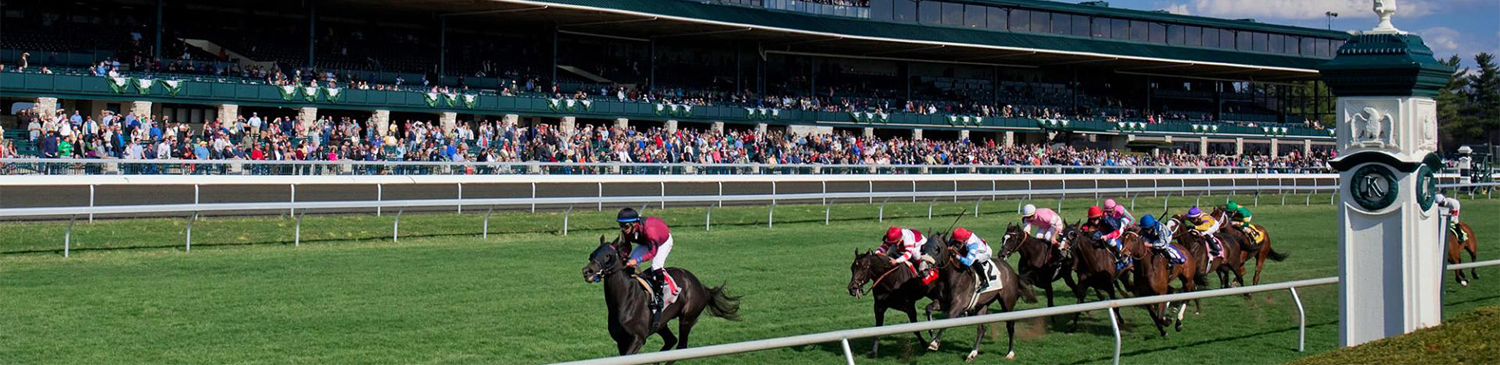
Keeneland Track Profile
For all the great racing and what it has meant to the history of Thoroughbred racing, Keeneland Race Course in Lexington, Kentucky is so much more than a racetrack.
No comparisons intended, but Keeneland, like iconic Saratoga Race Course in upstate New York, is a place that you feel. Somehow its popularity, history and its traditions all seem to waft through the air in this most bucolic of settings.
Several years ago, a grassroots horseplayers’ organization ranked Keeneland #1 among 65 North American racetracks because its quality racing, combined with takeout rates and betting menu, made it the most customer friendly on the continent.
Of greater import to the community and racing industry, Keeneland is included in the U.S. National Register of Historic Places and was designated a National Historic Landmark in 1986. High praise indeed for a structure that was opened a mere 50 years earlier.
But what is Keeneland, exactly? Is it a racetrack, or is it a sales company? Of course, the reality is that Keeneland is both after getting its start as a sales company.
Keeneland Association Inc. is registered as a business that includes two distinct divisions: Keeneland Race Course and Keeneland Sales, replete with a horse auction complex. And, as an homage to the sport, the Keeneland Library is a wonder for fans of racing history to behold.
Keeneland’s unique race meets—a 15-day Keeneland Spring meet and 17-day Keeneland Fall session--have put it in the position it enjoys today, arguably the country’s most substantive race meetings.
The 15-day Keenland spring stand features 15 graded stakes including the storied Blue Grass, one of the ‘Big Five’ Kentucky Derby prep races, joining the Florida Derby, Santa Anita Derby, Arkansas Derby and Wood Memorial.
But the 17-day fall session might be more impressive with respect to influence. Never mind 17 graded stakes, again matching the overall graded-stakes-per-day model, it’s the six Grade 1s that are the launching pad for November’s Breeders’ Cup participants.
The Keeneland Sales, inarguably the world’s most prestigious Thoroughbred auction, pre-dates the racetrack. The sales facility was built on a 147-acre tract of land owned by Jack Keene, who was the driving force behind the project.
In its earliest days, as it is now, the group known as the Keeneland Association have made significant contributions to not only the sport but the surrounding community, widely acknowledged as linchpin at the heart the revitalization of Lexington.
Not only is Keeneland among the newest, if not the newest significant racing venue erected in the U.S., in 1997 it was the last to install a race caller to describe the racing action. Keeneland’s tag-line to that point had been “racing as it was meant to be.”
After finally capitulating to the cultural demands of the last 20th century, Keeneland began to attract the attention of filmmakers in search of historical significance and ambiance.
Keeneland hosted most of the racing scenes from the 2003 hit movie, Seabiscuit, and also was used in the final momentous scene from Secretariat seven years later; the slow-motion head-on view of Big Red’s Triple Crown sweep.
But it is the Keeneland Sales that makes it all work. The largest auction facility in the world, it hosts three distinct auctions: the September Yearlings, November’s Breeding Stock, and January’s mixed Horses of All Ages sessions.
Keeneland also can lay claim to the title of world’s leading horse auctions: Through its ring has passed 82 Breeders’ Cup race winners, repeaters notwithstanding, 11 Horses of the Year, five Epsom Derby winners and 58 winners of the American Classics, including 19 Kentucky Derbies.
Of its 32 graded stakes, 10 are Grade 1, including the highly prestigious Makers 46 Mile Turf, Shadwell Turf Mile, Spinster and Queen Elizabeth II Challenge Cup. For juveniles, there are the Breeders’ Futurity and Alcibiades.
Keeneland is a 1-1/16 miles dirt oval surrounding a 7-1/2 furlong turf course with two configurations, the main and Haggin courses. The main track was converted to a synthetic surface in 2006 but Polytrack proved unpopular with many horsemen and bettors. It was re-converted to dirt in 2014.
There was a time not long ago when the prominent New York stables who wintered in South Florida returned to New York not long after the Florida Derby was run, but that no longer is the case.
The burgeoning popularity and prestige of the Keeneland spring meet is more than a stopover for the better horses returning north or those wishing to compete in Derby week festivities. Keeneland now stands squarely in the middle of the “good horse circuit.”