2025–26 Most Improved Futures: 5 Names Worth Watching (and Betting)

Summary
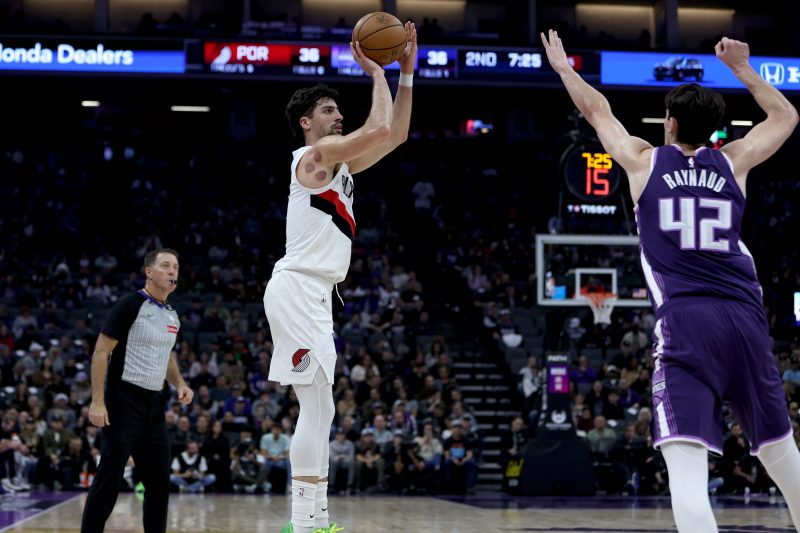
Halfway through the NBA season, the Most Improved Player race is defined by significant statistical leaps. Deni Avdija of Portland leads the conversation with a 51% scoring increase and a 69% spike in assists, transforming into a primary offensive hub. Atlanta’s Jalen Johnson, a close contender, shows a 26% scoring jump and a 66% increase in playmaking, posting near triple-double averages.
Other strong candidates include the Lakers’ Austin Reaves, with a 35% scoring boost on elite efficiency, and Utah’s Keyonte George, whose 42% scoring jump offers longshot value. Chicago’s Josh Giddey, averaging near a triple-double, completes the top tier. The award will likely go to a player whose expanded role and sustained production create the most compelling narrative by season’s end.
Halfway through the NBA season, the Most Improved Player race isn’t about vibes or hot takes—it’s about numbers. Who’s actually scoring more, creating more, and doing it efficiently enough to matter? Not every two-point bump in PPG qualifies as a breakout, and not every efficiency spike means a guy has fundamentally changed his game.
This isn’t about feel-good stories. It’s five players whose games — and roles — have taken a real leap, the kind that moves the needle in the MIP race and the futures market. The Christmas checkpoint gives us a real sample size — enough to separate true breakouts from early-season noise.
Let’s see who’s actually taken the leap in 2025.
1. Deni Avdija, Portland Trail Blazers
The Numbers
Last season in Portland: 16.9 points, 7.3 rebounds, 3.9 assists, 30.0 minutes.
This season in Portland: 25.5 points, 7.1 rebounds, 6.6 assists, 34.9 minutes.
That’s a 51% jump in scoring and a 69% spike in playmaking on just five extra minutes per game. The usage explosion is unmistakable—he’s gone from efficient complementary starter to primary offensive hub.
What Changed
When Portland acquired Avdija in June 2024, they hoped he’d blossom into exactly the type of player he’s showing this year—a versatile wing who could create, defend multiple positions, and take pressure off the guards. Last season was the warm-up. This year is the payoff.
The minutes bump is modest (30.0 to 34.9), but the role shift is seismic. Portland has moved him from secondary option to featured creator, deploying him as a point-forward in stretches where the backcourt thins out. Avdija himself has described running the offense as the “primary point guard” during injury windows, using those reps to sharpen his decision-making and paint penetration. The scheme isn’t asking him to spot up—it’s asking him to break defenses.
Most Improved Player Odds: +200
Avdija sits as the betting favorite, and the case is airtight: 51% scoring jump, 69% playmaking spike, expanded creation role, and maintained efficiency. It’s the textbook MIP profile—complementary starter becomes featured option, team-friendly contract suddenly looks brilliant, national buzz follows.
If Portland stays semi-competitive and Avdija doesn’t crater post-Christmas, he’s the logical choice. There’s not much edge here for sharp bettors hunting value, but if you want a single horse to ride with conviction, this is defensible chalk.
2. Keyonte George, Utah Jazz
The Numbers
Last season: 16.8 points, 5.6 assists, 31.5 minutes
This season: 23.9 points, 6.8 assists, 34.2 minutes
That’s a 42% scoring jump, a 22% playmaking increase, and massive efficiency gains across the board. Field goal percentage is up nearly six points, free-throw shooting has spiked into elite territory, and his three-point percentage has climbed from 34.3% to 36.2% on higher volume (7.6 attempts per game, up from 6.8).
What Changed
George spent year two caught between roles. Rookie Isaiah Collier’s emergence pushed him to the bench in 32 of 67 games last year. And while he publicly embraced the role — saying he’d impact the game “no matter what” — it was clear Utah was still figuring out how to use him.
Year three is where it is coming together. The Jazz stopped hedging and handed him the keys. He’s now initiating the majority of Utah’s half-court offense, running the show as a creator-first guard rather than a microwave scorer off the bench. The efficiency gains aren’t accidental—his shot selection has matured, his free-throw rate has climbed (4.3 to 7.4 attempts per game), and he’s converting those trips at an elite 90.7%. The three-point shooting is still a work in progress, but the overall profile shows a player who’s learned to weaponize his strengths while the efficiency catches up to the usage.
Most Improved Player Odds: +1600
This is the kind of number that makes sharp bettors pay attention. George has the classic young-guard MIP profile: big second-to-third-year scoring leap, assists up, efficiency way up, clear role expansion. The 42% scoring jump and 90.7% free-throw shooting are legitimately eye-popping, and the narrative—struggling rookie becomes franchise backcourt piece—writes itself.
The risk is visibility. Utah isn’t sniffing the playoff picture, and the national media doesn’t always reward breakouts on bad teams. If the Jazz stay buried in the lottery and George’s name doesn’t crack mainstream award conversations, voters might default to safer choices on winning rosters.
3. Austin Reaves, Los Angeles Lakers
The Numbers
Last season: 20.2 points, 4.5 rebounds, 5.8 assists
This season: 27.3 points, 5.4 rebounds, 6.5 assists
That’s a 35% scoring increase with across-the-board efficiency gains. Field goal percentage is up over four points, and he’s converting free throws at 87.3% on nine attempts per night—a massive jump in free-throw rate that signals increased aggression and usage.
What Changed
The arrival of Luka Doncic and JJ Redick’s hiring as head coach reshaped everything. Redick publicly declared Reaves an All-Star in their first conversation, framing him as a cornerstone rather than a complementary piece. The messaging from the organization has been unmistakable: “It’s as much his team as it is LeBron’s or Luka’s.” That’s not coddling—it’s a mandate.
Reaves responded by overhauling his offseason. He added strength and burst, showing up to camp visibly more explosive. The on-court results followed: he’s attacking downhill more frequently, getting to the free-throw line at career-best rates, and finishing through contact with consistency he didn’t have last year. His 51-point outburst against Sacramento in late October announced the arrival, and he’s sustained the elevated production since.
The role expansion is real. When LeBron or Doncic sits, Reaves steps into full primary initiator duties. When all three share the floor, he’s the connective tissue—secondary creator, transition threat, clutch-time decision-maker.
Most Improved Player Odds: +500
Reaves has the two things MIP voters love most: a big statistical leap and narrative juice. The undrafted-to-near-star arc plays beautifully, especially in a major market with primetime exposure. A 35% scoring increase with elite efficiency on a Lakers team expected to contend is the kind of profile that wins awards.
The risk is competition. If a true engine like Deni Avdija or Jalen Johnson sustains their leaps on comparable teams, Reaves might get framed as a co-star benefiting from elite teammates rather than the guy carrying the load. The Lakers’ star power cuts both ways—it amplifies his visibility but also complicates the “who deserves credit?” narrative. Voters might wonder how much of this is Reaves and how much is spacing created by LeBron and Luka.
4. Jalen Johnson, Atlanta Hawks
The Numbers
Last season: 18.9 points, 10.0 rebounds, 5.0 assists
This season: 23.8 points, 10.5 rebounds, 8.3 assists
That’s a 26% scoring jump and a 66% playmaking explosion on nearly identical minutes. The efficiency hasn’t just held—it’s improved. Field goal percentage is up over two points, three-point shooting has spiked from 31.2% to 37.8%, and his free-throw percentage has climbed to 82.3% on career-high volume (5.9 attempts per game).
The playmaking leap is the headline. Johnson has posted multiple triple-doubles this season, including the fastest in Hawks history (against Denver), and his recent 12-game stretch shows the consistency: 24.9 points, 11.1 rebounds, 8.8 assists per game.
What Changed
Full health matters. Johnson missed significant time last season with a shoulder injury and underwent surgery in the offseason. He’s now playing without restrictions, and the difference is obvious—his burst in transition, his finishing through contact, and his willingness to attack closeouts all grade higher than a year ago.
Atlanta added shooters like Kristaps Porziņģis, Luke Kennard, and Nickeil Alexander-Walker, giving Johnson the kind of floor spacing he never had before. Defenses can’t load up on his drives the way they did last year, and his improved three-point shooting (up eight percentage points) forces opponents to respect him on the perimeter. Quin Snyder’s system leans on Johnson’s versatility — he’s played the three, four, and even small-ball five. Snyder called him “our most versatile guy,” crediting his rebounding and playmaking as foundational.
The offense flows through him in ways it didn’t last season, and his ability to collapse defenses and make reads in traffic has turned him into one of the league’s more dangerous secondary creators.
Most Improved Player Odds: +225
Johnson sits as the 2nd betting favorite, and the case is airtight. A 26% scoring jump, a 66% playmaking explosion, improved efficiency across the board, and the kind of highlight-reel performances that drive national narrative—this is exactly what MIP voters reward. The triple-double resume, the All-Star-level production, and the fact that he’s doing it on a Hawks team trying to claw back into playoff contention all work in his favor.
The competition is stiff—Deni Avdija’s usage spike and Austin Reaves’ Lakers platform both have merit—but Johnson’s leap feels more complete. He’s not just scoring more; he’s facilitating at an elite level, rebounding like a power forward, and shooting well enough from deep to keep defenses honest.
5. Josh Giddey, Chicago Bulls
The Numbers
Last season: 14.6 points, 8.1 rebounds, 7.2 assists
This season: 20.0 points, 9.3 rebounds, 9.1 assists
That’s a 37% scoring increase with meaningful gains across the board. Rebounds are up 15%, assists are up 26%, and he’s flirting with triple-double averages nightly. He’s posted seven triple-doubles through 27 games, second-most in the NBA, and his December stretch (near triple-double averages with multiple 20-10-10 performances) has forced national attention.
What Changed
The trade from Oklahoma City to Chicago in the summer of 2024 unlocked everything. In OKC, Giddey was an inefficient, high-usage facilitator surrounded by a crowded backcourt and inconsistent spacing. In Chicago, he’s been handed the keys.
Billy Donovan’s system maximizes Giddey’s vision. He’s running pick-and-rolls as the primary initiator, pushing transition at every opportunity, and making live-ball reads with confidence. His assist rate has spiked (up from 7.2 to 9.1 per game), and tracking data shows he’s generating more primary assists rather than secondary swing passes. His decision-making has sharpened—fewer hero-ball possessions, quicker reads, better shot selection.
The organization views him as the long-term point guard, and his production has validated that faith. There’s been national chatter comparing his playmaking to peak LeBron-style facilitation, and local media have pushed hard for his All-Star candidacy.
Most Improved Player Odds: +900
Giddey sits at +900, which feels like legitimate value for a player posting near triple-double averages on a competitive team. The narrative is clean: player miscast in OKC finds the right system in Chicago, unlocks his potential, and drives a surprise playoff push.
The risk is visibility and competition. If the Bulls fade post-Christmas or Giddey’s production dips, voters might default to safer choices on better teams. The guard All-Star race in the East is crowded, and if he doesn’t make the team, the MIP buzz could stall. But at +900, this is the kind of number that rewards belief in second-half momentum
The Verdict: Separating Real Leaps from Market Noise
The Most Improved Player race rarely rewards subtlety. Voters want big jumps, clean narratives, and production that shows up in primetime. Jalen Johnson and Deni Avdija sit at the top of the odds board for a reason—their statistical leaps are undeniable, their roles are locked in, and their teams have given them the runway to sustain it.
Austin Reaves has the Lakers’ platform working in his favor, while Keyonte George and Josh Giddey represent live longshot value for bettors willing to bet on second-half momentum. The Christmas checkpoint has given us enough data to know who’s actually different. Now it’s about who can hold it through April—and which narratives the voters decide to reward.