Ranking NBA Greats to Never Win a Championship

Summary
Following a 21-season career, LA Clippers guard Chris Paul has announced his retirement. The 40-year-old, an 11-time All-NBA selection and future Hall of Famer, is poised to join the list of legendary players who never secured an NBA championship.
This group of elite players includes several all-time greats whose careers were often blocked by dominant dynasties. Karl Malone, a two-time MVP, tops the list, having reached the Finals three times without a win. Other notable names are John Stockton, Charles Barkley, Allen Iverson, and Reggie Miller. Despite their individual brilliance and numerous accolades, the ultimate team success of a title remained elusive for these legends.
LA Clippers guard Chris Paul announced he’s calling it quits after 21 seasons in the NBA. The 40-year old future Hall of Famer is a 2-time All-Star, an 11-time member of All-NBA teams and has been named to the All-Defense team nine times. Barring the Clippers winning a title in the spring, Paul will be one of the NBA greats to never win a championship. Here’s a list of legends of the game to never win a ring in their careers.
10. Reggie Miller
One of Michael Jordan’s fiercest rivals was also ahead of his time. Miller was one of the first players to specialize in 3-pointers and drained 2,560 during his career. Like others on this list, Miller and the Pacers were the victims of playing during the Bulls’ dynasty in the 1990s, blocking any chance of a title. And the one season they reached the Finals in 2000, they ran into Shaquille O’Neal, Kobe Bryant and the Lakers.
9. Elgin Baylor
Elgin Baylor averaged 27.4 points, 13.5 rebounds, was named Rookie of the Year and is in the Hall of Fame. He regularly finished in the top five of MVP voting and put up huge numbers, with the Los Angeles Lakers. But despite eye-popping stats, the one thing that stands out is no championship rings. You can blame the Boston Celtics’ dynasty that got in Baylor’s way of winning a title.
8. Carmelo Anthony
Few scorers have ever made buckets look as effortless as Carmelo Anthony, one of the most polished offensive weapons of his era. From jab-step jumpers to bruising post play, Melo’s bag was deep. He led the Nuggets and Knicks to multiple playoff runs, made 10 All-Star teams, and captured three Olympic gold medals as Team USA’s all-time leading scorer. But his teams rarely had championship-caliber support, and his defensive limitations often hurt playoff success.
7. Dominique Wilkins
“The Human Highlight Film” was more than just a jaw-dropping dunker—Dominique Wilkins was a prolific scorer with nine 25-plus-point seasons. His Hawks teams consistently won but had the misfortune of playing in the same era as the Celtics, Pistons, and Bulls—three of the most dominant franchises of the time. His classic 1988 duel with Larry Bird remains one of the greatest Game 7 performances ever, but the second round was usually his limit as Wilkins never made a Finals.
6. Patrick Ewing
The face of the 1990s New York Knicks, Patrick Ewing was a defensive anchor and a reliable mid-range scoring big. He led the Knicks to two NBA Finals (1994, 1999) and was the heart of one of the league’s toughest defensive teams. However, his era was dominated by Michael Jordan’s Bulls, and when the Bulls weren’t in the way, Hakeem Olajuwon’s Rockets were. Ewing performed at a Hall-of-Fame level for nearly two decades, but the championship stage ultimately proved elusive. Still, as an 11-time All-Star and franchise icon, his legacy remains enormous.
5. Charles Barkley
A force of nature at just 6’4″, Charles Barkley revolutionized what an undersized forward could be. He rebounded like a seven-footer, ran the break like a guard, and scored efficiently from inside and out. Barkley won the MVP in 1993, led the Suns to the Finals that year, and consistently carried teams far in the playoffs. But like so many greats, his prime collided with Jordan’s. Barkley came close several times, but postseason runs always ended just short.
4. Allen Iverson
One of the most iconic players in NBA history, Allen Iverson brought culture, passion, and fearless scoring to the league. The 2001 MVP carried an undermanned Sixers roster to the Finals and even stole Game 1 from the powerhouse Lakers with a legendary 48-point performance. Iverson led the league in scoring four times and remains one of the greatest pound-for-pound players ever—standing just six feet tall and 165 pounds. His lack of a ring is more a reflection of roster limitations than his own ability.
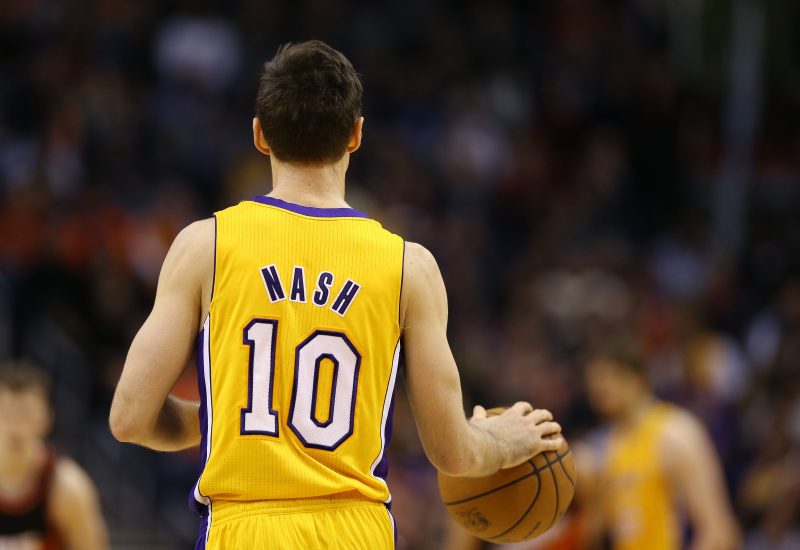
3. Steve Nash
A two-time MVP and the engine behind some of the most explosive offenses ever, Steve Nash made basketball beautiful. His Suns were pioneers of the modern pace-and-space era, and Nash is one of the best shooters in league history—even though he rarely looked for his own shot. Postseason misfortune, controversial suspensions, and elite Western Conference competition (Duncan’s Spurs, Kobe’s Lakers) repeatedly blocked Nash from the Finals.
2. John Stockton
The top two can really be interchangeable – but we’ll put John Stockton here as he was one of the greatest pure point guards to never win a title. Stockton’s records for all-time assists (15,806) and steals (3,265) are so untouchable that no active player is even close. He was an elite playmaker, a solid defender and a master of the pick-and-roll. But his path to a title was blocked by Michael Jordan and the Bulls.
1. Karl Malone
Jazz legend Karl Malone still holds the NBA record for playing the most playoff games
without a championship, appearing in 193 games. Utah reached the NBA Finals twice but lost to the Bulls (1997, 1998). Malone joined the Lakers in 2004 in one last attempt for a ring but L.A. would lose in the Finals to Detroit. Malone was a two-time MVP, scored nearly 37,000 points and earned 14 All-NBA and All-Star selections. He is the greatest player to never get his hands on that coveted Larry O’Brien Trophy.
Conclusion
A championship is often treated as the defining marker of basketball greatness, but the careers of these players prove otherwise.Rings, while important, don’t erase the brilliance these players brought to the league. Their legacies remain secure—etched into NBA history regardless of how many banners they lifted.