Five Most Undeserving Heisman Trophy Winners

Summary
Since its inception in 1935, the Heisman Trophy has occasionally been awarded to players considered less deserving than their peers. For instance, Notre Dame’s Tim Brown won in 1987 despite underwhelming statistics on a mediocre team, while Alabama’s Mark Ingram II benefited from a concerted push for a first-time winner from his school over more impactful players like Ndamukong Suh.
In 1997, Michigan’s Charles Woodson won largely due to his team’s undefeated record, overshadowing a statistically superior season from Peyton Manning. Similarly, Oklahoma’s Jason White in 2003 was chosen over standout receiver Larry Fitzgerald. Most recently, the compelling story of Colorado’s two-way player Travis Hunter in 2024 was deemed less worthy than the record-breaking season of Boise State’s Ashton Jeanty.
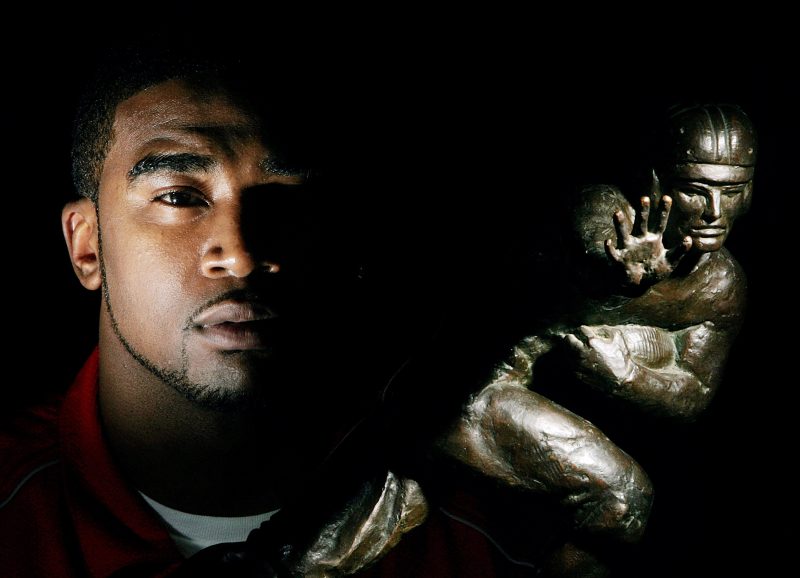
The most prestigious individual award in college football is the Heisman Trophy. This award has been presented annually since 1935 when Jay Berwanger of Chicago etched his name in history. There have been plenty of controversial winners over the last 90 years, but these five players are the most undeserving Heisman Trophy winners.
Tim Brown – WR Notre Dame (1987)
Notre Dame has benefited more from Heisman Trophy bias than any other university, and no player benefited more from playing for the Fighting Irish than Tim Brown. He was the first wide receiver to win the Heisman Trophy in the modern era, but Brown’s numbers during the 1987 season were incredibly underwhelming. The future NFL Hall of Fame receiver caught just 39 passes for 846 yards and three touchdowns. He didn’t shine in another role either with 34 carries for 144 yards and a touchdown as a rusher.
Typically, if a player with mediocre numbers wins the Heisman Trophy, he is on a team that is a national championship contender, if not outright winner. However, Notre Dame was just an above average team in 1987 with an 8-4 record. The Fighting Irish ended their campaign with three straight losses and were shut out by Miami 24-0 in their regular season finale.
Don McPherson of Syracuse, Thurman Thomas of Oklahoma State, and Emmitt Smith of Florida would all have been more deserving winners. McPherson was especially deserving as the Orange went 11-0-1 and finished the season ranked No. 4 nationally after he led the nation in passing yards per attempt and quarterback rating.
Mark Ingram II – RB Alabama (2009)
Alabama never had a player win the Heisman Trophy before Mark Ingram claimed the honor in 2009. That stat highlights some of the politics that go into this award, and many Crimson Tide fans were happy that one of their own was finally recognized. However, Ingram was not the most deserving winner despite an impressive stat line. Alabama’s superstar running back carried the ball 271 times for 1,658 yards and 17 touchdowns in 2009.
Ndamukong Suh should have won the award after an incredible season completely disrupting Big 12 offenses with Nebraska. Suh was brilliant against Texas in the Big 12 Championship Game, nearly leading the Cornhuskers to a conference title in their penultimate season with their former conference before joining the Big 10. Toby Gerhart, Colt McCoy, and Tim Tebow also had strong cases that were overshadowed by a concerted push from Alabama.
Charles Woodson – CB Michigan (1997)
Peyton Manning was the favorite to win the Heisman Trophy all throughout the 1997 season. However, voter exasperation coupled with a fourth straight loss to Florida doomed Manning even though he was clearly the best player in the land. Manning threw for 3,819 yards with 36 touchdowns and 11 interceptions as the Volunteers finished the regular season ranked No. 3.
Charles Woodson more than proved himself in the NFL, but Woodson was not nearly as important to Michigan as Manning was to Tennessee. Woodson finished the regular season with seven interceptions and returned 33 punts for 283 yards and a touchdown. The Wolverines had an elite defense and allowed just 8.9 PPG, but only a few teams in the Big Ten were throwing the ball often at the time. If Michigan had lost a game or two, Woodson’s candidacy would have waned, but Michigan finished the year unbeaten and split the national title with Nebraska.
Other strong candidates in the 1997 season were Randy Moss of Marshall and Ricky Williams of Texas. Moss was incredible with 90 receptions for 1,647 yards and 25 touchdowns, while Williams ran for 1,893 yards and 25 touchdowns while averaging 6.8 YPC.
Jason White – QB Oklahoma (2003)
The Oklahoma Sooners were a juggernaut in the early 2000s. Oklahoma was a perennial national title contender under Bob Stoops, and Jason White put up big numbers in Norman. White threw for over 3,800 yards with 40 touchdown passes and 10 interceptions, leading the Sooners to a No. 3 ranking in the Final AP Poll.
However, there were several players that would have been better choices this season. Larry Fitzgerald nearly beat out White for the award, and Fitzgerald would have looked much better in hindsight. The standout Pittsburgh receiver hauled in 92 passes for 1,672 yards with 22 touchdowns, leading the nation in all three categories even though a subpar quarterback was throwing him the football.
Darren Sproles of Kansas State, Matt Leinart of USC, and B.J. Symons of Texas Tech all finished among the top ten in Heisman Trophy voting that season. Sproles and Leinart had strong cases too, while Symons needed to be considered simply because of the gaudy numbers he posted in Mike Leach’s offense.
Travis Hunter WR/CB Colorado (2024)
There was no better story in college football than Travis Hunter last season. Hunter shined on both sides of the ball as a receiver and a cornerback, and that led to the Jacksonville Jaguars moving up to select him with the No. 2 overall pick. However, stories don’t necessarily mean that a player is the most deserving choice despite Hunter’s immense talent. Additionally, he also had an elite collegiate talent throwing him the ball in Shedeur Sanders,
Ashton Jeanty had a much more impressive season. Jeanty was incredible in leading Boise State to its first ever appearance in the College Football Playoff. He was the only real option for the Broncos’ offense, and he ran the ball for over 2,600 yards and found the end zone 29 times as a rusher. That allowed Maddux Madsen to have some success, and his deficiencies have become more glaring in 2025.
Cam Ward of Miami and Dillon Gabriel of Oregon would have been solid choices too. Ward was phenomenal and turned the Hurricanes into a title contender before the defense collapsed in November, while Gabriel led the Ducks to an unbeaten record in the regular season before Oregon fell to eventual national champion Ohio State in the Rose Bowl.