The NHL’s 5 Most Surprising Teams of 2025-26

Summary
The 2025-26 NHL season has been defined by surprising teams. The Buffalo Sabres, once struggling, now lead the Atlantic Division thanks to a franchise-record winning streak, tightened defense, and standout performances from Tage Thompson and Rasmus Dahlin. Similarly, the Anaheim Ducks’ young core, led by Cutter Gauthier, has accelerated their rebuild to top the Pacific despite defensive concerns. The Pittsburgh Penguins, fueled by a still-dominant Sidney Crosby and strong team defense, have also exceeded expectations by remaining a top Metro team.
Conversely, two presumed contenders have dramatically underperformed. The New York Rangers, with elite talent like Igor Shesterkin and Artemi Panarin, sit last in the Metro due to faltering goaltending and special teams. The Toronto Maple Leafs have collapsed defensively, ranking near the league’s bottom in goals and shots allowed despite offensive talent, putting them outside the playoff picture.
The 2025-26 NHL season has been a lot of things — chaotic, unpredictable, and genuinely difficult to handicap from week to week. Rebuilds accelerated ahead of schedule, veteran rosters cratered without warning, and a few teams that were supposed to be irrelevant by February are instead shaping playoff races.
Five teams stand out above the rest when it comes to defying expectations — three that exceeded them in a big way, and two that made you wonder what exactly happened to the team you thought you knew.
1) Buffalo Sabres
From 15-Year Punchline to Atlantic Division Leaders
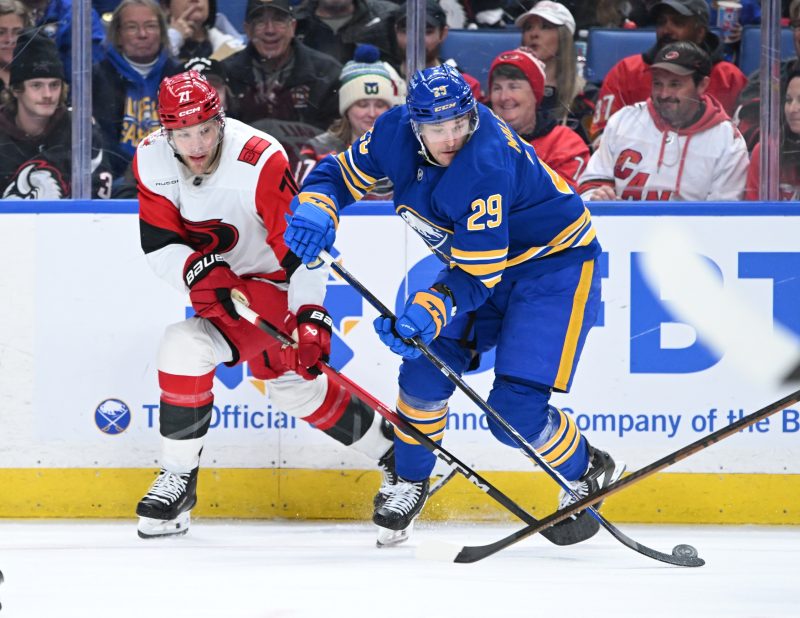
At 11-14-4, the Sabres looked like exactly what everyone expected them to be — another lost season, another footnote in one of the NHL’s longest playoff droughts. Then something shifted. The front office changed, the structure tightened, and Buffalo went on a 10-game winning streak that tied a franchise record and completely rewrote the narrative.
They haven’t just sneaked into the playoff race. They’re leading the Atlantic Division. This is not a fluke stretch anymore — this is a team that finally looks like they believe in themselves and are ready for a legitimate run.
BY THE NUMBERS
- 1st in the Atlantic
- 82.5% PK (4th)
- +35 Goal differential
- 3.51 GPG
Lindy Ruff finally has the defensive structure locked in — Buffalo stopped trying to outscore every mistake and started playing like a connected five-man unit. Once the goaltending stabilized from its early-season basement numbers, the whole thing clicked.
Tage Thompson (34 goals, 70 points) is still the engine, but the bigger story might be Rasmus Dahlin emerging as a true number-one defenseman in every sense — not just offensively but as the anchor of a blue line that now looks like an actual strength. Add in GM Jarmo Kekäläinen finally operating with urgency instead of patience, and you’ve got an organization that started making decisions like a team that expects to win.
The Biggest Questions?
The real questions now are whether the goaltending holds up through June and whether the power play is good enough to compete with the top contenders. That being said, they are playing with house money once they get into the playoffs, and that’s a team you never want to face.
2) Anaheim Ducks
The Rebuild Wasn’t Supposed to Look Like This — Not Yet
Nobody expected Anaheim to be a division race team this season. The Ducks were still supposed to be in the patient phase — accumulating, developing, maybe sniffing the wild card if things broke right. Instead, they’ve spent most of 2025-26 near the top of the Pacific, scoring at will, and looking to end a seven-year playoff drought in real time.
What makes this even more interesting is how they’re doing it. Anaheim’s underlying defensive numbers are still a mess. Their penalty kill is below average. Their goal differential doesn’t match their standings position. And yet — they keep winning. That’s either a testament to their offensive firepower or a warning sign about what happens in a playoff series. Maybe both.
BY THE NUMBERS
- 1st in the Pacific
- 215 Goals For
- 3.23 GPG
- Gauthier 32 goals so far
The engine driving all of this is the young core arriving ahead of schedule. Cutter Gauthier has turned into a legitimate goalscoring threat — 32 goals and the kind of release that forces opposing coaches to actually game-plan around him. Leo Carlsson is developing into the center that this rebuild was always banking on.
Joel Quenneville deserves monster credit here, too. The Ducks don’t just have better results under him — they look like a different team. More aggressive, more dangerous in transition, more confident. Lukas Dostal has steadied things behind a questionable defense, and veterans like Chris Kreider and Mikael Granlund gave the young core the support it had been missing.
The Biggest Question?
A negative goal differential sitting in first place is a flashing yellow light. The offense is real. The defensive holes haven’t been patched. Whether that equation holds in a playoff series is the legitimate question hanging over everything Anaheim has built this year.
3) Pittsburgh Penguins
The Retool That Refuses to Lose
The conversation around Pittsburgh this season wasn’t “how far can they go?” It was quieter than that — more like a waiting room discussion about when the Crosby era finally winds down and what a soft rebuild might look like. Kyle Dubas was expected to start making harder decisions. Dan Muse was supposed to be a transition coach. Instead, the Penguins are sitting second in the Metro with 79 points, and the teardown conversation got shelved rather quickly.
BY THE NUMBERS
- 79 points in 64 games — 2nd in the Metropolitan Division
- +24 goal differential
- 2.86 goals against per game (top-10 in the league)
- Power play: 25.1% | Penalty kill: 84.3%
- Sidney Crosby: 27 goals, 59 points at age 38
The biggest reason Pittsburgh is still relevant is obvious: Crosby. At 38, he’s still the heartbeat of this team, still dragging the standard upward on nights when the margin for error is thin. But the more interesting story is what’s happening around him. The Penguins are defending at a level most people didn’t see coming — 2.86 goals against per game is legitimately top-10 territory, and for a team carrying an aging roster, that kind of defensive foundation changes everything.
The Biggest Question?
This still isn’t an elite contender. The core is aging, the margin for error is thin, and if Crosby doesn’t get healthy for the playoffs, the whole thing gets shaky real fast.
4) New York Rangers
A Contender-Profile Roster That Forgot How to Contend
On paper, this Rangers team wasn’t supposed to be having this conversation. Igor Shesterkin. Adam Fox. Artemi Panarin. Mika Zibanejad. That’s not a bubble roster — that’s a Metro contender. Yet here they are, sitting at the bottom of the division with 60 points in 64 games, watching the playoff picture from the outside. Last in the Metro. This is another complete failure of a season.
BY THE NUMBERS
- -24 Goal Differential
- 77.8% PK (22nd)
- 25.5 S/PG (28th)
The formula the Rangers rode for years was simple: elite goaltending covers the cracks, special teams bail you out when the five-on-five game gets ugly. That formula required Shesterkin to be a nightly difference-maker. When that cushion softened this season, everything underneath it got exposed really fast.
The Biggest Question?
The talent on the roster is still real — a healthy, locked-in Shesterkin changes the team overnight. Can the Rangers do anything in the offseason to build their depth and get back into the mix next year while Shesterkin is still in his prime?
5) Toronto Maple Leafs
From Atlantic Champions to Watching the Playoff Door Close
Nobody expected the Leafs to repeat as Atlantic champions after losing Mitch Marner. That’s a fair and reasonable reset of expectations. What wasn’t expected — what nobody really saw coming — was this. Toronto is sitting outside the playoff picture with a -26 goal differential, ranked 30th in goals against, and dead last in shots allowed. This isn’t a step back. This is a collapse.
The brutal irony is that the offense isn’t even the problem. At 3.11 goals per game, the Leafs are still scoring. They win faceoffs at the best rate in the league. The penalty kill ranks fourth. On paper, there are real strengths here. But they give up 3.48 goals per game and allow 32.0 shots against — both bottom-of-the-league figures — and no amount of offensive production can compensate for that.
BY THE NUMBERS
- -26 Goal Differential
- 32 SA/G (32nd)
- 19.3 %PP (21st)
The defensive numbers aren’t just bad — they’re historically bad for a team that had legitimate playoff aspirations. Ranking 30th in goals against and last in shots allowed means opponents aren’t just scoring on Toronto, they’re generating volume at will.
Auston Matthews and William Nylander are still producing, and that’s part of what makes this so deflating for the Leaf fanbase. This is a roster-construction and defensive failure at a time when Matthews should be in his prime competitive window. The power play ranks 21st — a letdown for a team with this skill level — and the offense overall sits 17th. There’s no single fix here; the whole game plan for this team needs a major rethink heading into next year.
The Biggest Question?
Who’s still standing heading into next year? There’s been growing noise that the room has tuned out Craig Berube. He still has backing from management, but a shakeup feels likely.