Top 5 Most Impressive Rookie Performances in NBA History

Summary
While most rookies spend their first season adjusting, some deliver legendary performances that instantly redefine expectations. These moments combine staggering statistics, high stakes, and a lasting impact on the league’s narrative.
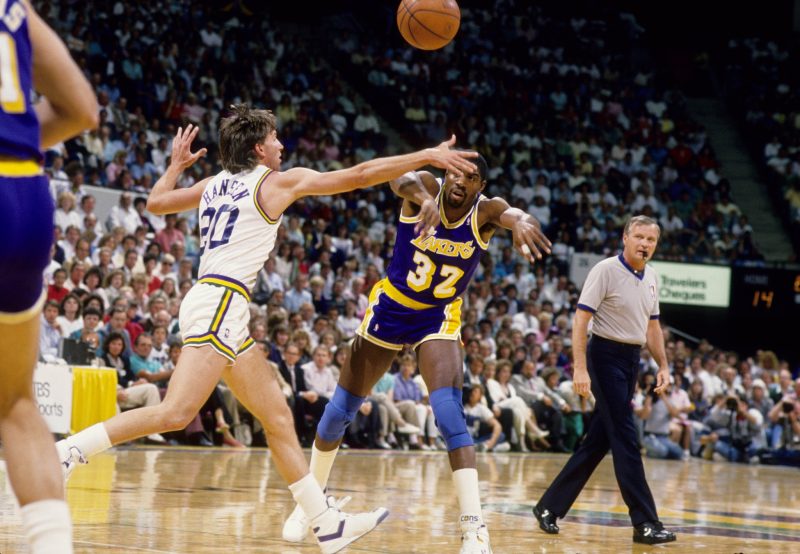
Magic Johnson’s 1980 Finals MVP performance, substituting for an injured Kareem Abdul-Jabbar with 42 points and 15 rebounds to win the championship, stands atop the list. Other historic feats include Wilt Chamberlain’s unmatched 58-point, 42-rebound game, Kareem’s 46-point, 25-rebound playoff closeout, LeBron James’ 37-point duel with Paul Pierce at age 18, and Cooper Flagg’s recent record-breaking 42 points as an 18-year-old. These games prove that transcendent talent requires no apprenticeship, establishing legends from their very first campaigns.
Rookie seasons are about adjustment—learning the speed, the physicality, the 82-game grind. Most first-year players spend their debut campaigns figuring out rotations, earning minutes, and trying not to embarrass themselves on national television.
Then there are those special nights when a rookie walks in and makes it obvious — he’s not waiting his turn. These aren’t just big stat lines. They are moments that change the temperature of the entire league. Stage matters. Context matters.
This list balances three things: box score insanity, historical impact, and narrative shift. Some of these games shattered records that remain unbroken to this day. Others announced a generational talent before anyone was ready to believe it. All of them proved that greatness doesn’t always wait for year two.
#1. Magic Johnson – May 16, 1980
The Lakers led the 76ers 3-2 in the NBA Finals, but Kareem Abdul-Jabbar severely sprained his ankle in Game 5 and stayed back in Los Angeles. Game 6. Philadelphia. Hostile crowd, title on the line — and the Lakers’ best player wasn’t on the floor. He was in a hospital bed. So 20-year-old Magic Johnson started at center, told his teammates, “Never fear, E.J. is here,” and then went out and played all five positions — against Julius Erving and a Sixers team that smelled blood.
The Stats
- 42 points, 15 rebounds, 7 assists
- 3 steals, 1 block
- 47 minutes in a road closeout game
- First rookie ever to win Finals MVP
The Impact
This wasn’t just the best rookie Finals performance—it might be the best Finals performance, period. Magic became the first and only rookie to win Finals MVP, delivering a 40-point double-double effort on the road with the championship at stake. It instantly redefined what a first-year player could be: positionless, fearless, and capable of carrying a title team when the stakes couldn’t be higher. Everything about Magic’s legacy—the showtime brilliance, the versatility, the winning—traces back to this single night in Philly.
#2. Wilt Chamberlain – January 25, 1960
It was just a regular-season game in Detroit. Wilt showed up at 23, already averaging 37 and 27, and turned Olympia Stadium into a bona fide crime scene. The Pistons had veterans like Gene Shue and Bailey Howell tasked with slowing down a 7’1″ force of nature who’d already dropped 44 points and 43 rebounds on Boston earlier in the year. They failed spectacularly.
The Stats
- 58 points (rookie single-game scoring record)
- 42 rebounds (that’s not a typo)
- 4 assists
- 58% FG on high volume, 10 for 13 at the line
The Impact
No rookie has ever scored more in a single game. No one. Wilt set the mark 65 years ago, and it’s still standing, which tells you everything about how absurd this performance was. The 42 rebounds feel like a glitch in the matrix—modern players don’t grab that many in a week. If Magic’s Game 6 owns the “moment” tier of rookie performances, Wilt’s 58-42 owns the “pure statistical violence” tier. It foreshadowed his 50-point season — and reminded everyone that some players don’t just define an era. They distort it.
#3. Kareem Abdul-Jabbar – April 3, 1970
The Bucks led the 76ers 3-1 in the Eastern Division Semifinals and had a chance to close out the series at home in Milwaukee. Philadelphia—led by Billy Cunningham and veteran Hal Greer—was a former contender trying to stave off elimination against an upstart franchise built around its 22-year-old rookie center. Kareem (then Lew Alcindor) had already dominated the regular season with 28.8 points and 14.5 rebounds per game. Now, in front of a raucous home crowd, he had the opportunity to stamp his first playoff series with authority.
The Stats
- 46 points (roughly 50% shooting)
- 25 rebounds (game-high)
- Heavy minutes (47+) in a 115-106 home win
- Became just the second rookie ever to post a 40-25 playoff game (Wilt was the first)
- Finished the 1970 playoffs averaging 35.2 PPG and 16.8 RPG
The Impact
This was the moment Kareem announced he wasn’t just Wilt’s successor—he was already operating at that level. Drop 46 and 25 in a playoff closeout as a rookie, and you’re not a prospect anymore — you’re a generational problem.
The skyhook was unguardable, the rebounding relentless, and the blueprint for six MVPs and 20 years of dominance was officially drawn. College stars don’t always translate to postseason executioners. Kareem did it immediately.
#4. LeBron James – December 13, 2003
An 18-year-old kid from Akron, carrying the weight of being “The Chosen One,” walked into the Fleet Center to face Paul Pierce and the Celtics. Pierce was in his prime, coming off an All-Star season, and Boston’s defense was built to suffocate young wings who believed their own hype. LeBron had already shown flashes through his first two months in the league, but this was the first time he’d share the floor with a legitimate alpha scorer in a genuine shootout. The question wasn’t whether he belonged—it was whether the hype was real.
The Stats
- 37 points (18-year-old single-game scoring record at the time)
- 10-of-20 FG (50%), 16-of-18 FT (88.9%)
- 3 rebounds, 4 assists
- 45 minutes of floor time as an 18-year-old
- Paul Pierce went for 41 points in the duel
The Impact
This was the “told you so” performance that quieted early skeptics and announced LeBron as a legitimate NBA scorer, not just a marketing construct. The 37 points stood as the 18-year-old scoring record for over two decades, and the efficiency—50% shooting, 16-of-18 from the line—showed poise beyond his years in a hostile road environment. Pierce got his 41, but LeBron matched him stride for stride, proving he could trade buckets with an All-Star wing in his physical prime. It became the cornerstone of his Rookie of the Year campaign and the first real evidence that Cleveland had drafted a franchise-altering player. The hype wasn’t just real—it was underselling him.
#5. Cooper Flagg – December 15, 2025
The Mavericks rolled into Salt Lake City with a 10-16 record, clinging to recent momentum after winning five of six. Cooper Flagg, the No. 1 overall pick, was averaging 25.7 points over his last seven games, but this was still a rebuilding Dallas squad facing a young Jazz team hungry for consecutive wins. The Delta Center crowd was live, the stakes were low, and the 18-year-old was about to make everyone forget about the final score.
The Stats
- 42 points (13-of-27 FG, 48.1%)
- 7 rebounds, 6 assists
- 2 blocks, 1 steal
- 41 minutes in an overtime loss
- First 18-year-old ever to score 40+ in an NBA game
- Broke LeBron James’ 18-year-old scoring record (37 points, set in 2003)
The Impact
This may be the moment Cooper Flagg went from “generational prospect” to “he’s already here.” Breaking a LeBron record before turning 19 is the kind of marker that defines a career arc before it’s even started. The 42 points came with genuine two-way versatility—rebounds, playmaking, rim protection—making it clear this wasn’t just a hot shooting night. Flagg tied Mark Aguirre’s Mavericks rookie scoring record and became the fifth rookie in 15 years to post a 40/5/5 line. The loss stung, but the performance announced that Dallas didn’t just draft upside—they drafted a franchise cornerstone who can carry offensive loads immediately.
Honorable Mentions
- Rick Barry – 57 PTS vs Knicks (Dec. 14, 1965)
An efficient mid-range heater that helped cement him as a premier scorer almost immediately. - Earl “The Pearl” Monroe – 56 PTS vs Lakers (Feb. 13, 1968)
Guard-driven scoring clinic; early proof that this was a different kind of backcourt star. - Brandon Jennings – 55 PTS vs Warriors (Nov. 14, 2009)
Seventh career game. 21-of-29 from the field, 5-of-8 from three. Out-of-nowhere explosion that no one saw coming.
Defensive Mastery
- Manute Bol – 15 BLK vs Hawks (Jan. 25, 1986)
Rookie record for blocks in a game; turned the paint into a no-fly zone. - Ron Harper – 10 STL vs Cavaliers (Mar. 10, 1987)
Rookie steals record; a one-man passing-lane crime spree.
All-Around Mayhem
- Michael Carter-Williams – 22 PTS, 12 AST, 7 REB, 9 STL in his debut (Oct. 30, 2013 vs Heat)
Nearly a quadruple-double against the defending champs in his very first game. - Dalton Knecht – 9 made threes (Nov. 19, 2024 vs Jazz)
Ties the single-game rookie three-point record, including a stretch where he scores 21 straight Laker points.
Greatness Doesn’t Need a Learning Curve
These five performances represent the ceiling of what’s possible for a first-year player—the nights where rookies didn’t just meet expectations, they rewrote them entirely. From Wilt’s statistical violence to Magic’s positionless mastery in the Finals, these games became the benchmarks every hyped prospect gets measured against.
Some players take years to find their footing in the NBA. These five walked in and immediately made everyone else adjust to them. That’s not just impressive—that’s how legends get built in a single night.