What Every Central Division Team Is Facing This NHL Season

Summary
The NHL’s Central Division is a powerhouse, featuring three elite Stanley Cup contenders at the top. A fierce battle for first place is expected between the Dallas Stars, who added Mikko Rantanen to create a dominant top line, and the Winnipeg Jets, who rely on goaltender Connor Hellebuyck. The Colorado Avalanche, despite trading Rantanen, remain dangerous with Nathan MacKinnon and Cale Makar. The middle of the division is a volatile scrum of teams, where one club is projected to reach 95 points yet still miss the playoffs.
Several teams are locked in a tight race for the final postseason spot. The Minnesota Wild, St. Louis Blues, and Utah Mammoth are all projected around 95 points, with their success hinging on factors like special teams and goaltending consistency. Further down, the Nashville Predators hope for a bounce-back season, while the Chicago Blackhawks are focused on developing their young core, including Connor Bedard, and are not expected to be competitive.
The Central is the NHL’s heavyweight division—three legitimate Cup contenders at the top, a chaotic scrum of “maybe playoff teams” in the middle, and two franchises in completely different stages of development at the bottom.
The division race most likely be between Dallas and Winnipeg battling for the top spot, Colorado lurking as the dangerous third seed all season, and then complete chaos for the final playoff spot. Someone’s going to get 95 points and miss the playoffs. That’s Central Division hockey—elite at the top, volatility everywhere else. Let’s break it all down, team by team.
Dallas Stars: Rantanen Makes This a Right Now Problem
Dallas didn’t add Mikko Rantanen to compete—they added him to win the whole damn thing before the cap reality destroys their roster. A full season of Rantanen alongside Jason Robertson and Roope Hintz gives them a top line that can bury opponents in three shifts, and when Wyatt Johnston’s lurking as your second-line center with prime power play touches, you’re not building for the future, you’re cashing chips now.
Miro Heiskanen and Thomas Harley provide elite puck-moving from the back end, Jake Oettinger stabilizes the crease, and Pete DeBoer’s possession-first system keeps them in control of pace. But here’s the urgency nobody’s hiding: Robertson and Harley are due massive raises after this season, which means the window isn’t closing—it’s already half-shut.
One Thing to Watch
Whether the Rantanen-Robertson-Hintz line meshes immediately and becomes the unstoppable force Dallas mortgaged its flexibility to create. On paper, it’s perfect—Rantanen’s carry-in gravity and cross-ice vision unlocks Robertson’s delayed release, Hintz provides transport and defensive responsibility, and suddenly you’ve got three legitimate threats who can all finish and create.
If they get going early and the top line dominates, with the power play firing at 25–27% behind Rantanen’s presence, Dallas is the Central favorite and a serious Cup threat. If the chemistry takes months to develop or never quite reaches its ceiling, they’re still very good but not cup-bound.
Best/Worst Case Scenarios
- Best Case: Rantanen line becomes must-watch TV, PP rockets to top-3, Oettinger steady at .920, Johnston hits 70+ points — 114-118 points, top-2 in West, legitimate Cup favorite
- Worst Case: Second pair bleeds rush chances against speed, PP chemistry lags, depth scoring inconsistent — 100-104 points, still dangerous but first-round vulnerable
The Verdict
They’re primed to hit 105 to 110 points because the talent level won’t allow anything less. Rantanen should hit 95-100 points in a full season with elite linemates and power play usage, Robertson pushes 90-95 points with the space Rantanen creates, and Hintz grinds out 75-80 points while handling defensive responsibility.
Johnston’s the breakout candidate—prime usage bump, net-front power play touches, and late-game draws push him toward 75 points and potential awards consideration. Heiskanen continues to be one of the league’s best all-situation defensemen and racks up 65-70 points.
The power play should be elite—you can’t defend Rantanen and Robertson on opposite flanks simultaneously, and when Hintz works the bumper with Johnston screening, there’s no good option. But that second defensive pair is a concern—Esa Lindell and Matt Dumba provide steadiness but can get stretched by speed, and if teams exploit that matchup in the playoffs, suddenly Dallas is leaking odd-man rushes they can’t afford. This is a Cup-or-bust season, whether they admit it publicly or not.
Projections
108-114 points (median: 111) | 1st-2nd in Central | Playoff odds: 92-96%
Winnipeg Jets: Can the Hometown Kid Inspire A Cup Run?
Connor Hellebuyck won the Hart and Vezina, the Jets posted 116 points and the league’s best goal differential, and then everyone asked the same question: “Okay, but can they do it in May?” Year Two under Scott Arniel answers that question, except now they’re doing it without Nikolaj Ehlers’ creativity and transition pop.
The foundation remains elite—Hellebuyck’s still the league’s best goalie, Josh Morrissey drives exits and quarterbacks the power play, and the Kyle Connor-Mark Scheifele-Gabriel Vilardi line can tilt matchups. But replacing Ehlers means asking Cole Perfetti to take a massive usage leap while veterans Jonathan Toews, Gustav Nyquist, and Tanner Pearson provide depth stability.
One Thing to Watch
Cole Perfetti’s usage spike and whether he can replace Ehlers’ playmaking and transition creativity as a legitimate top-six driver. Perfetti’s got the half-wall vision and poise—he’s been ready for bigger minutes—but going from sheltered third-line usage to potentially running a second line with veterans is a massive jump. If Perfetti hits 60-65 points while driving shot quality on the second unit and providing power play production, Winnipeg’s depth scoring stabilizes, and they’re not relying solely on the top line.
If he struggles with the increased responsibility or gets overwhelmed by tougher matchups, suddenly their middle-six is veteran committee work without a true driver, which worked in the regular season but gets exposed in the playoffs when depth scoring decides every series.
Best/Worst Case Scenarios
- Best Case: Perfetti breaks out to 65 points, PP stays top-3, Hellebuyck rested and sharp, veterans provide consistent depth — 112-116 points, top seed in West, finally breaks Round Two ceiling
- Worst Case: Middle-six finishing sputters without Ehlers, PK leaks seams, Hellebuyck workload stacks up — 100-104 points, familiar playoff disappointment
The Verdict
They’re getting back to 109-112 points because Hellebuyck won’t allow anything less. Connor pushes 100 points as the primary shooter, Scheifele hits 75-80 points as the dual-threat center, and Vilardi continues his 60-65 point production with net-front finishing and power play value.
Perfetti’s the swing—if he hits 60-65 points, the depth looks deep; if he plateaus around 50, the offense gets thin fast. Toews won’t put up numbers, but he’ll win faceoffs, handle penalty kill duties, and provide late-game matchup insurance. The defensive structure under Arniel remains tight—Dylan DeMelo and Josh Morrissey eat tough matchups, Neal Pionk provides secondary support, and they’ll surrender the fewest or second-fewest goals in the league again.
The elephant in the room: Winnipeg’s been great in the regular season for years, and it never translates to wins in playoff hockey. They need to prove they can win ugly games, score net-front goals when structure breaks down, and match intensity when opponents ratchet everything up. The talent says they should be a Cup contender. The track record says they’re a regular-season juggernaut who disappears in May. This roster gets one more chance to prove which narrative is true.
Projections
108-113 points (median: 110) | 1st-2nd in Central | Playoff odds: 90-94%
Colorado Avalanche: Life After Moose Means Committee Offense
Trading Mikko Rantanen was either an organizational necessity or franchise malpractice, depending on how the next six months unfold. Nathan MacKinnon and Cale Makar remain the thunder-and-lightning core that can tilt any series, Gabriel Landeskog’s back for a full season providing net-front economy and leadership, and Jared Bednar’s still one of the league’s best tactical minds.
But replacing a 100-point winger with Martin Nečas and Brock Nelson—no matter how talented—means asking everyone to do a little more. Mackenzie Blackwood stabilizes the crease after last year’s goaltending carousel, Brent Burns adds a second power-play bomb from the point, and the depth looks deeper with actual veterans instead of AHL shuttles. The question isn’t whether Colorado’s still good—they obviously are. It’s whether “very good” is enough when Dallas added Rantanen and Winnipeg’s defense remains suffocating.
One Thing to Watch
Whether Martin Necas can drive a legitimate second line and provide the transition creativity Colorado lost in the Rantanen trade. Necas has the tools—dual-threat playmaking and finishing, transition pop, offensive zone vision—but he’s never been asked to be the guy on a scoring line for a contender.
If he hits 70-75 points while creating chances for Artturi Lehkonen and generating offense independent of MacKinnon, suddenly Colorado’s depth looks dangerous and the Rantanen trade makes strategic sense.
Best/Worst Case Scenarios
- Best Case: Landeskog near vintage form, Blackwood steady at .915, Necas hits 75 points driving second line, PP spikes to top-3 with Burns — 110-114 points, Central contender, legitimate Cup threat
- Worst Case: Blue-line injuries stack, PP stalls without Rantanen’s gravity, crease wobbles, Necas struggles with increased role — 96-100 points, Wild Card grind
The Verdict
MacKinnon’s getting 110-115 points regardless of who’s around him—the man’s an MVP-caliber force who drags linemates to career years. Makar continues his Norris-level dominance quarterbacking everything, and Landeskog should hit 60-65 points if the body cooperates after missing significant time.
The power play gets interesting with Burns adding a right-shot bomb to complement Makar’s wizardry, which might actually diversify their looks enough to compensate for losing Rantanen’s one-timer threat. Blackwood needs to be steady, not spectacular—.912-.915 with competent rebound control keeps them in every game, and Wedgewood provides reliable backup minutes.
The Central’s murderer’s row means 107-109 points might only get them third, which sets up a potential second-round Dallas matchup that nobody in Colorado wants to see. They’re talented enough to win the Cup if everything clicks—MacKinnon and Makar guarantee that ceiling—but the margin for error shrank considerably when Rantanen was traded.
Projections
104-110 points (median: 107) | 2nd-3rd in Central | Playoff odds: 88-92%
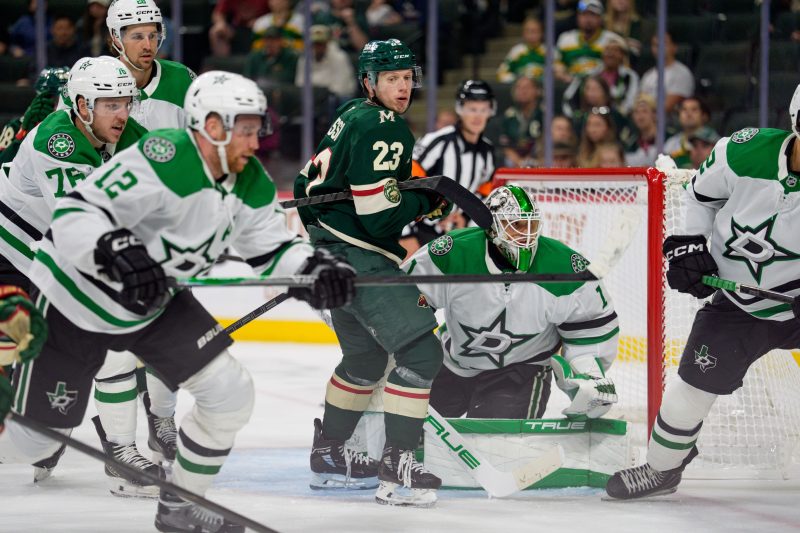
Minnesota Wild: Kaprizov’s Locked In, Everything Else Is Question Marks
Kirill Kaprizov signed a monster long-term contract, which immediately transforms Minnesota from “star on an expiring deal” anxiety to “legitimate cornerstone locked up” stability. Matt Boldy’s trending toward all-situations stardom, Marco Rossi graduated from prospect to legitimate two-way center, and Joel Eriksson Ek continues winning every matchup assignment thrown at him.
But here’s the reality: they finished with a negative goal differential last year despite 97 points, the power play ranked 20th, the penalty kill was 30th, and Mats Zuccarello’s out 7-8 weeks to start the season. Asking a team that couldn’t score or prevent goals on special teams last year to suddenly fix both problems while losing a top-six winger for two months feels optimistic.
One Thing to Watch
Whether the special teams can climb from disaster (20th on PP, 30th on PK) to even league average, because that’s literally the difference between playoff contention and another lottery pick. Minnesota’s five-on-five structure under John Hynes is sound—Jared Spurgeon and Jonas Brodin defend intelligently, Eriksson Ek shuts down top lines, and Kaprizov creates offense regardless of circumstances.
But when you’re bleeding goals on the penalty kill and can’t convert power play opportunities, you’re giving back points faster than you can earn them. Buium’s puck-moving should help the power play with dual-threat looks alongside Spurgeon, and if Rossi’s bumper timing frees up Kaprizov and Boldy on the flanks, maybe they push toward 21-22%.
Best/Worst Case Scenarios
- Best Case: PP clicks early to 21-22%, Kähkönen settles at .910+, Buium handles top-four minutes, Zuccarello returns healthy — 98-102 points, Wild Card 1 with upset potential
- Worst Case: Special teams stagnate, Zuccarello setback extends absence, goalie carousel continues — 84-88 points, sellers by deadline
The Verdict
Kaprizov, if healthy, is going to produce regardless—85-90 points even in a down year, 100+ if everything clicks. Boldy should push 75-80 points with increased all-situations usage and power play touches, Rossi hits 60-65 points as the two-way pivot who can finish, and Eriksson Ek grinds out 45-50 points while winning every defensive assignment.
The goaltending’s a complete question mark—the jury is still out on whether Gustavsson is a legit #1 goalie. If he falters, they turn to the young Jesper Wallstedt, who was their #1 pick back in 2021. The goalie situation is going to be a rollercoaster ride all season long, and don’t be surprised if they go shopping mid-season for some help.
All in all, they are probably landing around 93-96 points, which in the Central means fighting for the final Wild Card spot while hoping Nashville or St. Louis collapses.
Projections
92-98 points (median: 95) | 4th-5th in Central | Playoff odds: 35-45%
Nashville Predators: When Star Power Meets Structure Problems
Nashville spent big money on Steven Stamkos, Jonathan Marchessault, and Brady Skjei, then proceeded to post the worst season in franchise history at 30-44-8. The talent didn’t suddenly forget how to play hockey—Juuse Saros had a rare down year at .896, the team shooting percentage cratered to 8.8%, and the rush defense leaked goals like a sieve.
Year Three under Andrew Brunette is about fixing the fundamentals while letting the stars actually be stars. If Saros bounces back to his .915+ form and the power play stops wasting elite talent, they’re climbing back toward respectability. If the goaltending stays broken and the defensive structure keeps collapsing, this becomes a “blow it up and start over” conversation by December.
One Thing to Watch
Whether Juuse Saros can rebound from his career-worst .896 save percentage and return to being the elite goaltender who’s carried Nashville for years. Saros’s struggles weren’t just bad luck—his east-west control wavered, rebound suppression disappeared, and multi-goal bursts against became routine.
Saros needs to prove last year was an aberration, not a trend. If he returns to .915+ territory over 56-60 starts, Nashville immediately gains 8-10 points in the standings through goaltending alone. If he plateaus around .900 or struggles with consistency, they’re cooked regardless of how talented the forward group looks on paper.
Best/Worst Case Scenarios
- Best Case: Saros rebounds to .915+, PP climbs to 21%, Luke Evangelista pops as legitimate 2C, Stamkos/Marchessault finish consistently — 93-96 points, Wild Card 2 with upset potential
- Worst Case: Goaltending remains problematic, center depth wobbles, Josi limited by workload/injury, rush defense still leaks — 76-82 points, sellers by March
The Verdict
The center depth behind O’Reilly is concerning—Luke Evangelista’s an RFA who needs to prove he can drive a second line, and after him it’s Erik Haula and a prayer. The power play has to be elite with this talent—you can’t have Stamkos, Forsberg, Josi, and Marchessault on the ice and rank 20th. If they climb to 20-21% efficiency, that’s 15-20 extra goals that swing close games.
I have them bouncing back this year to around an 87-90 point season, which in the Central means fighting for the final Wild Card spot or missing by a handful of points. Everything hinges on Saros—if he’s elite, they’re dangerous. If he’s average, they’re lottery-bound despite the expensive roster.
Projections
86-92 points (median: 89) | 7th in Central | Playoff odds: 20-30%
Chicago Blackhawks: Bedard’s Time To Shine Without Training Wheels
The first year under Jeff Blashill as the new coach is about building an actual structure around the franchise centerpiece, Connor Bedard. Frank Nazar provides speed and finishing as a potential 2nd line centre, Alex Vlasic anchors the defense with legitimate matchup ability, and Spencer Knight gets a full starter’s runway to prove he can be the long-term answer in net. The blue line features a parade of first-round picks—Kevin Korchinski, Artyom Levshunov, Sam Rinzel—who’ll take their lumps while learning NHL pace. This isn’t a playoff team, it’s not trying to be a playoff team, and anyone expecting immediate success is missing the point entirely. Success means cleaner breakouts, improved special teams, and Bedard’s development continuing without the chaos overwhelming everything.
One Thing to Watch
Whether Connor Bedard and Frank Nazar develop a legitimate one-two punch up the middle that becomes the foundation of Chicago’s offense for the next decade. Bedard’s got the vision and playmaking to be generational, Nazar brings speed and retrieval skills that complement perfectly, and if they click as a PP1 duo, suddenly Chicago has a two-man engine that opponents actually have to game-plan for.
Bedard finished with 67 points in his sophomore year despite playing on a historically bad team—if Nazar provides consistent finishing and takes pressure off him to do everything, Bedard’s pushing toward 80-85 points while learning to be a true number-one center.
Best/Worst Case Scenarios
- Best Case: Bedard-Nazar chemistry clicks for 100+ combined points, Levshunov handles top-four by New Year, Knight posts .910, visible systems improvement — 74-78 points, competitive losses instead of blowouts
- Worst Case: Young defense bleeds goals, Knight struggles with workload, finishing depth non-existent, special teams stay broken — 62-68 points, another lottery season
The Verdict
Bedard’s ceiling should be at least a 75-80 point season even in a developmental system because it’s time for his talent to overcome the lack of depth. Nazar should push toward 50-55 points if he sticks as the #2 center and gets power play time.
Vlasic continues his quiet defensive growth while putting up solid stats, and the young defensemen—Korchinski, Levshunov, Rinzel—will make mistakes while showing flashes. Knight needs to be league average at .905-.910 to keep games from becoming unwatchable, and the backup situation better be solid or they’re giving away points on back-to-backs.
They’re still looking at a 68-74 point season, finishing bottom-five in the Central, and getting another high lottery pick. But the goal isn’t playoffs—it’s showing visible improvement in structure, breakouts, and special teams while Bedard develops properly instead of being ruined by organizational dysfunction.
Projections
68-76 points (median: 72) | 8th in Central | Playoff odds: 3-6%
St. Louis Blues: Can the Spring Heater Become Year-Round Heat?
St. Louis closed last season on a 129-point pace over the final 26 games, pushed Winnipeg to the brink in the playoffs, and now everyone’s asking the obvious question: was that a preview or a mirage? Robert Thomas emerged as a legitimate line-driving center, Jordan Kyrou found consistency beyond highlight-reel rushes, and the defensive structure under Jim Montgomery tightened considerably.
Jordan Binnington remains volatile but capable, and if the special teams inch toward respectability, St. Louis is more than a cute story. But sustainability’s the concern—that late-season surge had shooting luck baked in, and asking a young core to maintain that level for 82 games is how you end up with another 88-point season where everyone talks about “what could have been.”
One Thing to Watch
Whether Dylan Holloway makes the leap from “promising young player” to “legitimate 30-goal scorer who changes matchup math.” Holloway brings forecheck pressure, middle-six finish, and pace that the Blues desperately need beyond their top line.
If he hits 25 to 30 goals while providing secondary scoring that takes pressure off Thomas-Kyrou-Buchnevich, suddenly St. Louis has depth that matters. The offer sheet was bold—seven years at significant money—which means management believes he’s more than a complementary piece. If he validates that faith, the Blues suddenly have two scoring lines instead of one dangerous trio and a bunch of grinders.
Best/Worst Case Scenarios
- Best Case: Holloway hits 30 goals, Broberg locks top-four minutes, Binnington steady at .912+, Thomas maintains spring form — 98-102 points, Wild Card 1, legitimate upset threat
- Worst Case: Spring heater regresses to mean, depth scoring dries up, PK continues leaking, Binnington hot-cold volatility — 84-88 points, sellers by March
The Verdict
Binnington’s the wild card—if he strings together “quiet” nights at .910-.913, they’re competitive every game. If he swings between brilliant and catastrophic like usual, they’re giving back points they can’t afford to lose. Thomas is going to continue to shine, looking at 85 point season driving the top line with improved consistency. Kyrou should give us another 30-goal season if he maintains the two-way responsibility and finishing touch he showed in the spring.
Montgomery’s structure keeps them in games, but they’re probably landing around 93-96 points, which might be enough for a Wild Card in a messy Central race or might leave them two points short. The spring surge proved they can play with anyone when everything clicks. The question is whether “everything clicks” for six months or just six weeks.
Projections
92-98 points (median: 95) | 5th-6th in Central | Playoff odds: 35-45%
Utah Mammoth: Year Two Means No More Excuses
The inaugural season honeymoon’s over—now Utah has to prove they’re building something real. Clayton Keller remains the captain and primary creator, Logan Cooley and Dylan Guenther showed legitimate NHL skill upside, and the additions are meaningful: JJ Peterka on a long-term deal adds finishing punch, Mikhail Sergachev provides elite puck-moving from the back end.
They’re still young, still learning to finish consistently, and still playing in a Central Division that features Dallas, Winnipeg, and Colorado at the top. Being interesting isn’t enough anymore—they need to find another level to be considered dangerous.
One Thing to Watch
Whether JJ Peterka’s addition unlocks a legitimate second scoring line that diversifies Utah’s offense beyond “feed Keller and hope.” Peterka brings a transition burst and finishing touch that could either complement Barrett Hayton and Nick Schmaltz on a second unit or potentially slot onto the top line with Keller and Cooley, which would be fun to watch. If Peterka hits 30 goals and creates legitimate two-line scoring depth, suddenly opponents can’t just key on Keller every shift. If he struggles to find chemistry or the finishing stays inconsistent, they’re right back to being a one-line team hoping for goaltending to steal games.
Best/Worst Case Scenarios
- Best Case: Peterka hits 28 goals, Sergachev dominates PP touches, Vanecek steady at .912+, Cooley/Guenther both hit 70 points — 98-102 points, Wild Card 1, scary playoff matchup
- Worst Case: PP stagnates, defensive pair chemistry wobbles, tandem merely average, kids show inconsistency — 84-88 points, just outside by April
The Verdict
Vanecek needs to be steady—.910-.913 with good rebound control to keep them in every game. The power play has weapons now with Sergachev walking the line, Keller orchestrating from the half-wall, and Peterka/Guenther providing one-timer threats.
If they climb from middle-of-the-pack to 21-22%, that’s the difference between 92 points and 98 points. Keller’s producing 85-90 points regardless of circumstances—the man’s a legitimate star who creates offense from nothing. Peterka’s anywhere from 20-30 goals depending on chemistry and role, Hayton stabilizes at 45-50 points as the two-way second-line center, and Sergachev should crack 50-55 points while eating 23-24 minutes and quarterbacking the power play.
I have them hovering around 93-96 points, which in the Central might be enough for a Wild Card or might leave them agonizingly close. This is a team that should make the playoffs if things break right—the talent’s there, the goaltending’s legitimate, and Tourigny’s structure keeps them competitive.
Projections
92-98 points (median: 95) | 5th-6th in Central | Playoff odds: 40-50%
Central Division Final Standings Prediction
- Dallas Stars – 111 points
- Winnipeg Jets – 110 points
- Colorado Avalanche – 107 points
- Minnesota Wild – 95 points
- St. Louis Blues – 95 points
- Utah Mammoth – 95 points
- Nashville Predators – 89 points
- Chicago Blackhawks – 72 points