What Every Metropolitan Division Team Is Facing This NHL Season

Summary
The Metropolitan Division is fiercely competitive, with the Carolina Hurricanes, Washington Capitals, and New Jersey Devils forming the top tier. Carolina is a dominant force, adding Nikolai Ehlers’ speed to an already suffocating system, while Washington aims to prove last season’s success was sustainable. New Jersey’s potential hinges entirely on the health of star Jack Hughes. The rest of the division, including the New York Rangers and Columbus Blue Jackets, will likely battle for Wild Card positions, with their success depending on key factors like goaltending and young players breaking out.
Projected standings place Carolina first with 109 points, followed by Washington (105) and New Jersey (103). The Rangers (98) and Blue Jackets (91) are next, with the Philadelphia Flyers (82), New York Islanders (84), and Pittsburgh Penguins (79) rounding out the division. Ultimately, team fortunes will be decided by critical variables such as Hughes’ health for the Devils, stable goaltending for Columbus, and a coaching turnaround for the Rangers.
The Metropolitan Division is a knife fight in a phone booth—and half the combatants showed up with dull blades. Carolina remains the conference’s relentless nightmare, adding Nikolai Ehlers’ speed to a system that already suffocated opponents through territorial dominance. Washington’s trying to prove last year’s 111 points weren’t an Ovie-inspired mirage, and New Jersey’s a legitimate 100-point team if Jack Hughes’ shoulder actually cooperates for once. Those three are the class—everyone else is fighting for Wild Card scraps or lottery positioning.
Carolina Hurricanes: The Relentless Machine Added A New Weapon
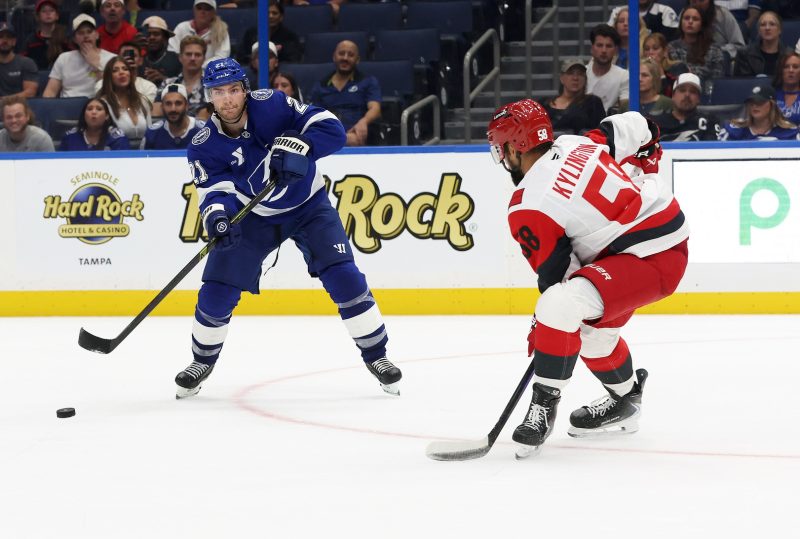
Rod Brind’Amour’s system is a beautiful, suffocating nightmare for opponents: aggressive 2-1-2 forecheck, D-men activating on retrievals, and enough volume shooting to make goaltenders question their career choices. Now they’ve added Nikolai Ehlers’ speed and controlled entries to a top six that already featured Sebastian Aho’s play-driving brilliance and Seth Jarvis’ finishing touch. The defense is as sound as can be—Jaccob Slavin and K’Andre Miller form a stopper pair that erases rush chances, while Nikishin and Gostisbehere provide different flavors of offensive activation.
One Thing to Watch
Seth Jarvis’ goal total. He’s locked into prime usage with PP1 bumper duties, and if the Ehlers addition creates more chaos and clean looks, Jarvis has a legitimate 35 to 40 goal pathway. That’s not just a career year for him—it’s the difference between Carolina’s power play going from merely good (18-19%) to elite (22%+), which cascades into everything else they do.
Best/Worst Case Scenarios
- Best Case: PP pops to 22%, Andersen stays healthy, Ehlers and Svechnikov fly all season — 114-116 points, Presidents’ Trophy chase
- Worst Case: Goalie injuries pile up, PP stalls around 18%, finishing variance strikes again — 99-102 points, still 3rd/4th Metro
The Verdict
Carolina cruises to 109 points, dominates territorially like they always do, and finally has the rush pop to finish what their system creates. Jarvis hits 38 goals, Slavin and Miller erase the opposition’s best players, and the Hurricanes bank early points before anyone realizes they’ve added another gear. The only thing that stops them is goaltending health or playoff finishing variance—but in the regular season, they’re a freight train with an additional weapon this year.
Projections
106-112 points (median: 109) | 1st-2nd in Metro (lean: 1st) | Playoff odds: 90%
Read more: What Every Atlantic Division Team Is Facing This NHL Season
New Jersey Devils: Can Hughes Stay Healthy?
Sheldon Keefe’s first season tightened the defensive structure and improved New Jersey’s chance share, but the offense dried up late and cost them precious points. Jacob Markstrom stabilizes the crease, and if Jack Hughes can stay healthy—his shoulder history remains the elephant in the room—this roster has legitimate 100-point upside. Hughes and Jesper Bratt form one of the league’s best transition duos, Nico Hischier provides two-way excellence and finishing touch, and Dougie Hamilton quarterbacks a power play that should click.
One Thing to Watch
Jack Hughes’ health and games played. When he’s on the ice, New Jersey’s a different team—the transition game flows, the power play hums, and suddenly everyone else has more space. But shoulder issues derailed him last year, and if he misses significant time again, the entire offensive structure collapses. His availability is literally the difference between 103 points and fighting for a Wild Card.
Best/Worst Case Scenarios
- Best Case: Hughes plays 75+ games, Markström posts .912, Meier hits 35 goals, young D step up — 106-108 points, Metro 2nd
- Worst Case: Hughes misses 20+ games again, goaltending stays mediocre, secondary scoring vanishes — 94-97 points, Wild Card scramble
The Verdict
If Hughes stays healthy and Markstrom provides the league-average goaltending they’ve been missing, it’s a launchpad to a 100-point season. Bratt hits 85 points, Hischier cracks 30 goals again with power play touches, and Luke Hughes posts 52 points with extra PP time. The defensive structure Keefe installed keeps them competitive even when the offense slumps. But everything—and I mean everything—hinges on Hughes’ shoulder holding up. If it does, they’re a legitimate contender. If it doesn’t, it’s another year of “what could have been.”
Projections
100-106 points (median: 103) | 2nd-3rd in Metro | Playoff odds: 75-80%
Columbus Blue Jackets: The Kids Are Fast, Fearless, and One Goalie Away
Columbus improved by 23 points last season and nearly made the playoffs behind Zach Werenski’s Norris-caliber season (82 points from the blue line) and a legitimately exciting youth movement. Adam Fantilli’s transport ability, Kirill Marchenko’s finishing, Kent Johnson’s skill—this forward group can score in bursts. Here, however, is the brutal reality: goaltending volatility killed them down the stretch. Elvis Merzļikins’ save percentage swings wildly, and while Jet Greaves showed promise, betting on a young goalie to stabilize 35-40 starts is hoping, not planning.
One Thing to Watch
Jet Greaves’ workload and performance. If he wins a legitimate 1B role and posts league-average save percentages over 35 starts, that alone is worth 6-8 standings points compared to what they got last year. Columbus doesn’t need elite goaltending—they just need competent, consistent stopping so their offense can actually win the games their structure creates. That’s the entire season right there.
Best/Worst Case
- Best Case: Fantilli hits 30 goals, Werenski stays healthy, Stable goaltending, defensive mistakes decrease — 94-97 points, Wild Card 2
- Worst Case: Goaltending stays volatile, young D make costly mistakes, late-season collapse repeat — 84-87 points, another near-miss
The Verdict
Columbus scratches and claws to 91 points and spends the entire season on the Wild Card bubble, occasionally looking like a team ready to break through and occasionally looking like they’re still a year early. Werenski posts an easy 70 points, Fantilli hits 30 goals, and Marchenko cashes 32 with PP1 time. The offense is real, the youth is exciting, and the speed overwhelms tired defenses at home. But goaltending volatility and defensive mistakes from the young second pair mean every losing streak feels existential. They’re knocking on the door—the question is whether the crease will let them through this year or make them wait another season.
Projections
88-94 points (median: 91) | 4th-6th in Metro | Playoff odds: 35-40%
New York Rangers: Sullivan’s Structure Meets Broadway’s Star Power
Last season was a disaster for the Rangers—they scraped together only 85 points and missed the playoffs altogether. They promptly fired their coach and brought in Mike Sullivan to install the defensive structure that’s been missing for years. They traded Chris Kreider and lost K’Andre Miller, which hurts, but added Vladislav Gavrikov to eat defensive zone minutes and free up Adam Fox for offense. The blueprint is simple: Artemi Panarin and Mika Zibanejad still generate elite chances, Fox quarterbacks everything, and Igor Shesterkin erases mistakes while Sullivan’s north-south 1-2-2 system reduces the track meets that killed them last year.
One Thing to Watch
Alexis Lafrenière’s breakout potential. He’s getting top-six minutes and PP2 touches, and if he hits 30 goals and 65+ points, New York suddenly has the secondary scoring they desperately need. But if he stays stuck in the mid-20s goal range, then the Rangers will be too dependent on Panarin and Zibanejad, and every cold streak from those two becomes an existential crisis.
Best/Worst Case Scenarios
- Best Case: Lafrenière hits 30 goals, Shesterkin posts .920, Fox bounces back to 75 points, Sullivan’s system clicks — 101-104 points, Metro 3rd
- Worst Case: Lafrenière plateaus, goaltending stays merely average, defensive depth issues — 91-94 points, Wild Card miss
The Verdict
The Rangers bounce back and grind out 98 points through defensive structure and Shesterkin stealing games, but the offense will feel thinner without Kreider’s finishing presence. Panarin hits 92 points, Fox rebounds to 72 with more offensive zone usage, and Lafrenière posts 27 goals—good, but not quite the breakout year they need. Sullivan’s system makes them harder to play against and keeps them competitive in one-goal games, but the lack of depth scoring means they’re fighting for Wild Card positioning instead of challenging for the division.
Projections
96-101 points (median: 98) | Metro 3rd/WC1 | Playoff odds: 60-65%
Pittsburgh Penguins: What Happens With Sid The Kid?
Sidney Crosby is still elite at 38—he managed to hit 91 points last year through sheer force of will—but even generational talent can’t overcome a sub-.900 team goaltending save percentage forever. The Penguins missed the playoffs for the third straight season, fired their coach, and brought in Dan Muse to install simpler breakouts and better slot protection. The youth injection offers hope for internal growth, but banking on rookies to save a sinking ship is a dangerous game. If this team is on the outside looking in come trade deadline time, the Crosby watch officially begins.
One Thing to Watch
Tristan Jarry’s performance. If he rebounds to .905 or better, Pittsburgh’s floor rises from the mid-70s to the low-80s in points, and they’re at least interesting. If he stays sub-.900 or loses time to Arturs Silovs or Joel Blomqvist, every defensive mistake becomes a goal, and Crosby’s loyalty may wear thin.
Best/Worst Case Scenarios
- Best Case: Jarry rebounds to .907, Koivunen sticks for 48 points, PP climbs to average, Crosby stays healthy — 83-86 points, outside but respectable
- Worst Case: Goaltending stays sub-.900, injuries hit aging core, youth struggles — 72-76 points, bottom of Metro
The Verdict
Pittsburgh finishes near the bottom again with 79 points because Crosby (85+ points) and Karlsson keep them competitive enough to avoid total disaster, but the goaltending and defensive leaks doom any playoff hopes. Rakell hits 30 goals, Drew O’Connor provides 33 points of pace and PK value, and one rookie—probably Koivunen—claims a top-six spot. But watching Crosby waste his final elite seasons on a roster this flawed feels like organizational malpractice.
Projections
76-83 points (median: 79) | 7th-8th in Metro | Playoff odds: 15-20%
New York Islanders: An Offense That’s Running on Fumes
The Islanders are in transition, whether they want to admit it or not. They missed the playoffs with 82 points, lost Noah Dobson’s puck-moving ability, and are now asking an aging core—Anders Lee, Kyle Palmieri, Ryan Pulock, Adam Pelech—to squeeze out one more competitive season while prospects develop. Ilya Sorokin remains elite (.924 last season, 2.71 GAA despite injuries in front of him), and Patrick Roy’s low-event system keeps games close enough for Sorokin to steal.
One Thing to Watch
Mathew Barzal’s health and availability. When he’s on the ice, he’s the only Islander who can consistently create entries and drive play at an elite level. His presence is worth 15+ standings points—the difference between competing for a playoff spot and finishing sixth in the Metro. If he stays healthy, the Islanders are at least interesting. If he doesn’t, they’re watching the lottery.
Best/Worst Case Scenarios
- Best Case: Barzal plays 72 games, Sorokin posts .920, Romanov steps up defensively, rookie impact late — 88-91 points, Wild Card bubble
- Worst Case: Barzal misses significant time, offense stalls, aging core shows wear — 76-80 points, bottom of Metro
The Verdict
The Islanders most likely finish with around 84 points and miss the playoffs again. Sorokin wins 30 games and posts a 2.65 GAA behind a structure that protects him, but when you score 2.3 goals per game, even elite goaltending can only carry you so far. Matthew Schaefer represents the future, but will it be this season or next? Sorokin playing at an elite level masks a roster that’s running on fumes.
Projections
80-88 points (median: 84) | 6th-7th in Metro | Playoff odds: 25-30%
Washington Capitals: Last Year Was Real, But Don’t Expect a Repeat
Let’s be honest—Washington exceeded all expectations last season. With a dominant run atop the Eastern Conference and Ovie making history, the big question now is whether it was sustainable or simply a perfect storm. Spencer Carbery’s system prioritizes heavy F1 pressure and quick middle exits instead of track meets, which suits this veteran, mean-and-heavy roster perfectly. But here’s the reality check: 111 points required special teams running extremely hot and winning a ton of one-goal games.
One Thing to Watch
Logan Thompson’s workload management. If he handles 55-58 starts and posts .910-.915 save percentages behind improved slot protection, Washington stays comfortably in the playoff picture even if the special teams cool off. If he gets overworked or the defense leaves him exposed, the regression becomes ugly fast, and suddenly they’re fighting for Wild Card positioning instead of home ice.
Best/Worst Case Scenarios
- Best Case: Thompson posts .915, Wilson hits 32 goals, Leonard sticks in top six, PP stays elite — 108-110 points, Metro title chase
- Worst Case: Special teams regress hard, Thompson merely average, depth D injuries — 96-99 points, Wild Card 1
The Verdict
Washington remains a legitimate Metro contender, just not the conference juggernaut they were last season. Thompson provides steady goaltending, Chychrun and Carlson run a nasty dual-QB power play, and Ovechkin amazingly grinds toward another 40 goals from his left-dot office. The regression from 111 points is real—special teams won’t stay that hot, one-goal game luck normalizes—but the core identity and upgrades keep them firmly in the playoff picture. They’re a second-round ceiling team unless everything breaks right again.
Projections
102-108 points (median: 105) | 2nd-3rd in Metro | Playoff odds: 85-90%
Read more: What Every Central Division Team Is Facing This NHL Season
Philadelphia Flyers: Michkov’s Star Power Must Shine
The Flyers finished with the fewest regulation wins in the East and immediately pivoted: Rick Tocchet arrives to install structure, Trevor Zegras comes in to juice controlled entries and power play touches, and Matvei Michkov gets unleashed as the offensive headliner this rebuild desperately needs. But here’s the elephant in the room: Samuel Ersson and Ivan Fedotov combined for .883/.880 save percentages last year, cratering otherwise decent 5-on-5 play. Dan Vladar joins as a real threat to claim the starter’s job if Ersson doesn’t improve.
One Thing to Watch
Combined goaltending save percentage from Ersson and Vladar. Last year’s .883 team save percentage cost Philadelphia at least 6-8 standings points. If they can get to .905—not elite, just competent—that alone vaults them from 75 points to the low-80s. Everything else (Michkov’s scoring, Zegras’ playmaking, York and Sanheim’s possession) becomes relevant only if the goaltending isn’t actively working against them every night.
Best/Worst Case Scenarios
- Best Case: Goaltending hits .907, Michkov scores 34 goals, Zegras drives second line, PP climbs to 18% — 86-89 points, Wild Card bubble
- Worst Case: Goaltending stays sub-.895, PP remains stagnant, center depth collapses — 74-78 points, bottom of Metro
The Verdict
Philadelphia flirts with 82 points and lives on the playoff fringe all season, occasionally exciting with Michkov’s skill (33 goals) and sometimes frustrating when the goaltending craters another winnable game. Konecny grinds out 75 points, Zegras provides 58 with his playmaking, and Tyson Foerster hits 26 goals riding shotgun. Tocchet’s structure helps, the power play improves from catastrophic to merely below-average, and York-Sanheim continues to prove they’re a legitimate top D pair. They’re a team in transition—talented enough to be dangerous on their best nights, flawed enough that the floor stays uncomfortably low.
Projections
78-86 points (median: 82) | 5th-7th in Metro | Playoff odds: 25-30%
Metropolitan Division Standings Prediction (2025-26)
- Carolina Hurricanes – 109 points
- Washington Capitals – 105 points
- New Jersey Devils – 103 points
- New York Rangers – 98 points
- Columbus Blue Jackets – 91 points
- Philadelphia Flyers – 82 points
- New York Islanders – 84 points
Pittsburgh Penguins – 79 points